
THE CAPTION: BEYOND THE PHOTOGRAPH
A field guide to reporting, note-taking, captions, contact information and archival responsibility
BOYD’S STATION | PROJECT 306.36
100% CAPTION COMPLETION — EVERY IMAGE, WITHOUT EXCEPTION
Every photograph ingested into Project 306.36 must have its own accurate, detailed, frame-specific caption and all required IPTC/XMP metadata. This applies to ALL images, regardless of whether they are selects, rejects, duplicates, technically imperfect, unedited, untoned, unpublished, or unlikely to appear in a portfolio. There is no reduced documentation standard for any part of the photographic take.
Photographers must enter the information—preferably in Photo Mechanic IPTC/XMP fields—before uploading to the Boyd’s Station archive server. Each image must document the identifiable people or subjects, the specific visible action or scene, the verified location and date, and relevant reporting context; required keywords must also be included. Shared background may be applied to a sequence only when accurate for every frame, and must never replace the description of what is actually shown in each photograph.
Missing information must be pursued and verified. An honestly marked provisional caption may be used only as a temporary, tracked exception while reporting continues; it is not a waiver of the requirement and does not count as completed archival documentation. Never invent names, circumstances, dates, or other facts. Privacy-sensitive contact details belong in approved restricted fields or secure reporting records, not public captions.
Archiving the complete take is not the same as publishing it. Boyd’s Station may limit public access to particular images, but all ingested images still require documentation. Photographers—not editors, staff, or future archivists—are responsible for completing this work. Delivering a handful of polished favorites while leaving the rest undocumented does not fulfill the residency.
The complete photographic take must be preserved and delivered, including unselected and unedited frames, under the approved RAW/JPEG archival workflow. Archiving does not mean every image will be published or made publicly accessible. Failure to caption and document the full take is a failure to meet a central requirement of the residency, regardless of the quality of a photographer’s personal selects.
When identification or reporting cannot reasonably be completed by the upload deadline, enter an honest provisional frame-specific caption, flag exactly what remains unverified in the restricted reporting log, and complete the follow-up promptly. Such photographs remain private and are not considered archive-ready until resolved or documented as genuinely unobtainable after reasonable effort. Sensitive contact information belongs in restricted reporting records, never public captions or metadata.
Photographers should apply captions and metadata through Photo Mechanic before uploading. Every image must have a description that accurately matches that frame; verified names and positions where applicable; precise capture date and location; meaningful reporting context; relevant keywords; creator and credit information; and Persons Shown metadata when people are visible. Shared factual background may be applied to related frames, but generic captions pasted across a take without checking each image are unacceptable. Never invent missing information.
Boyd’s Station is building a permanent documentary and historical archive of Harrison County. The program is not designed for photographers to edit a small personal portfolio and submit only their strongest pictures. An ordinary frame today may be invaluable decades later, but only if future researchers can establish who or what it depicts, where and when it was made, and the circumstances surrounding it.
THIS IS A NON-NEGOTIABLE CONDITION OF PARTICIPATION IN PROJECT 306.36. Every photograph ingested during the residency must receive a detailed, accurate, frame-specific caption and required IPTC/XMP metadata before upload to the Boyd’s Station archive server. This applies to ALL images in the complete take—not only selects, favorites, toned photographs, or pictures intended for publication.
REPORTING TOOLS AND CAPTION WORKFLOW
The method is flexible. The standard is not. Photographers may use camera-linked audio notes, smartphone voice memos, handwritten notebooks, cellphone notes, or Word, Google Docs and other working documents to gather facts, verify spellings, record quotations and draft captions. Use the approach that helps you report accurately and consistently. Obtain permission for recording when appropriate, and safeguard private contact information.
Photographers should establish a reliable Photo Mechanic workflow at the beginning of the residency. Use IPTC/XMP metadata templates, appropriate batch-entry tools and image-by-image review to transfer verified reporting into the correct image files before archive upload. Shared background details may be entered across multiple photographs, but each frame must still have an accurate, detailed caption describing its own content. A Word document, notebook, voice memo or generic batch caption does not fulfill the archival requirement.
Make this a daily practice: collect names and background in the field, draft captions while details are fresh, verify missing information, apply captions and required metadata to every ingested image, and check completeness before uploading. Never invent missing information. Record unresolved facts honestly and pursue them promptly; provisional notes are not finished captions.
EVERY INGESTED IMAGE MUST CONTAIN ITS OWN CAPTION AND REQUIRED METADATA. NO SELECTS-ONLY EXCEPTION.
ONE PHOTOGRAPHIC RECORD. TWO MATCHING ARCHIVES. EVERY IMAGE ACCOUNTED FOR.
Every image file uploaded to the Boyd’s Station archive server must have an exact corresponding copy on the hard drive provided to the photographer. Both locations constitute the official Project 306.36 photographic record. Neither is an optional backup, a portfolio selection, or a substitute for the other.
EXACT MATCH REQUIRED: File names, folder names, folder hierarchy, complete image inventories, frame-specific captions, keywords, photographer credits, dates, locations, and all required IPTC/XMP metadata must correspond between the uploaded archive and the provided hard drive. Where metadata is stored in XMP sidecar files, those files must be included and matched as well.
The requirement applies to ALL ingested images, including unselected, unedited, repetitive, technically imperfect, and unpublished frames. Photographers may maintain separate personal edits or selects, but those do not replace or alter the required matching archival copies.
Corrections to filenames, captions, folder organization, or metadata must be synchronized to both locations. A correction made only on the hard drive or only on the archive server does not fulfill this requirement. Photographers must verify that files and their corresponding metadata have been successfully transferred and remain readable.
MANDATORY HARD DRIVE TURNOVER AT THE END OF THE RESIDENCY
At the conclusion of the residency, each photographer must turn over the Boyd’s Station-provided hard drive containing the complete, organized, fully captioned photographic record. This physical delivery is required IN ADDITION TO the completed archive already uploaded to the server. The provided drive is project equipment and must not be retained as the photographer’s personal storage device.
Before departure, photographers must reconcile the two archives and confirm matching file counts, exact filenames and folder paths, captions, and required metadata. Any missing, mismatched, or incomplete material must be corrected. Boyd’s Station may review both copies before accepting final delivery.
ARCHIVAL DELIVERY IS NOT COMPLETE UNTIL THE SERVER ARCHIVE IS COMPLETE, THE MATCHING HARD DRIVE IS TURNED OVER, AND EVERY INGESTED IMAGE IS ACCOUNTED FOR.
MANDATORY STANDARD — EVERY INGESTED IMAGE MUST BE CAPTIONED
Photographs tell us what a moment looked like. Reporting preserves who was there, what happened, where it happened, and why it mattered.
A successful Project 306.36 photograph is not complete merely because it has been made, edited or uploaded. The photographer must report the scene, verify the facts, write a frame-specific caption, enter accurate metadata, retain field notes and make reasonable efforts to collect follow-up contact information. The resulting record must be useful to an editor today and a historian decades from now.
The five obligations
· IDENTIFY the principal people and their relationship to the scene.
· DESCRIBE the actual visible moment—not simply the event or assignment.
· REPORT what cannot be seen: relevant background, history, motivation and verified quotations.
· VERIFY names, dates, real geographic locations, spellings and claims.
· PRESERVE private follow-up contacts and field notes; review and correct the archive.
CAPTION GOLD-STANDARD EXAMPLE
Why this is an exceptional documentary caption
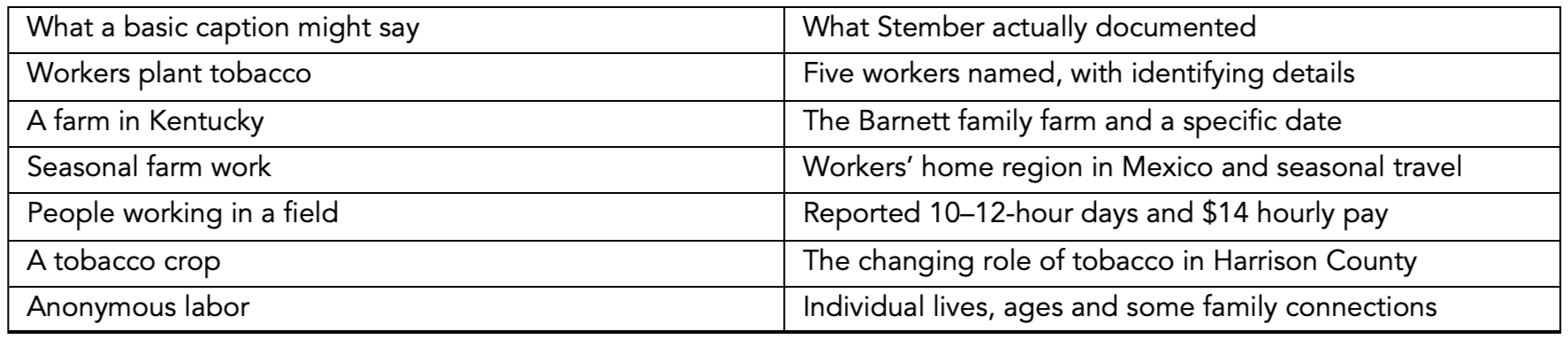
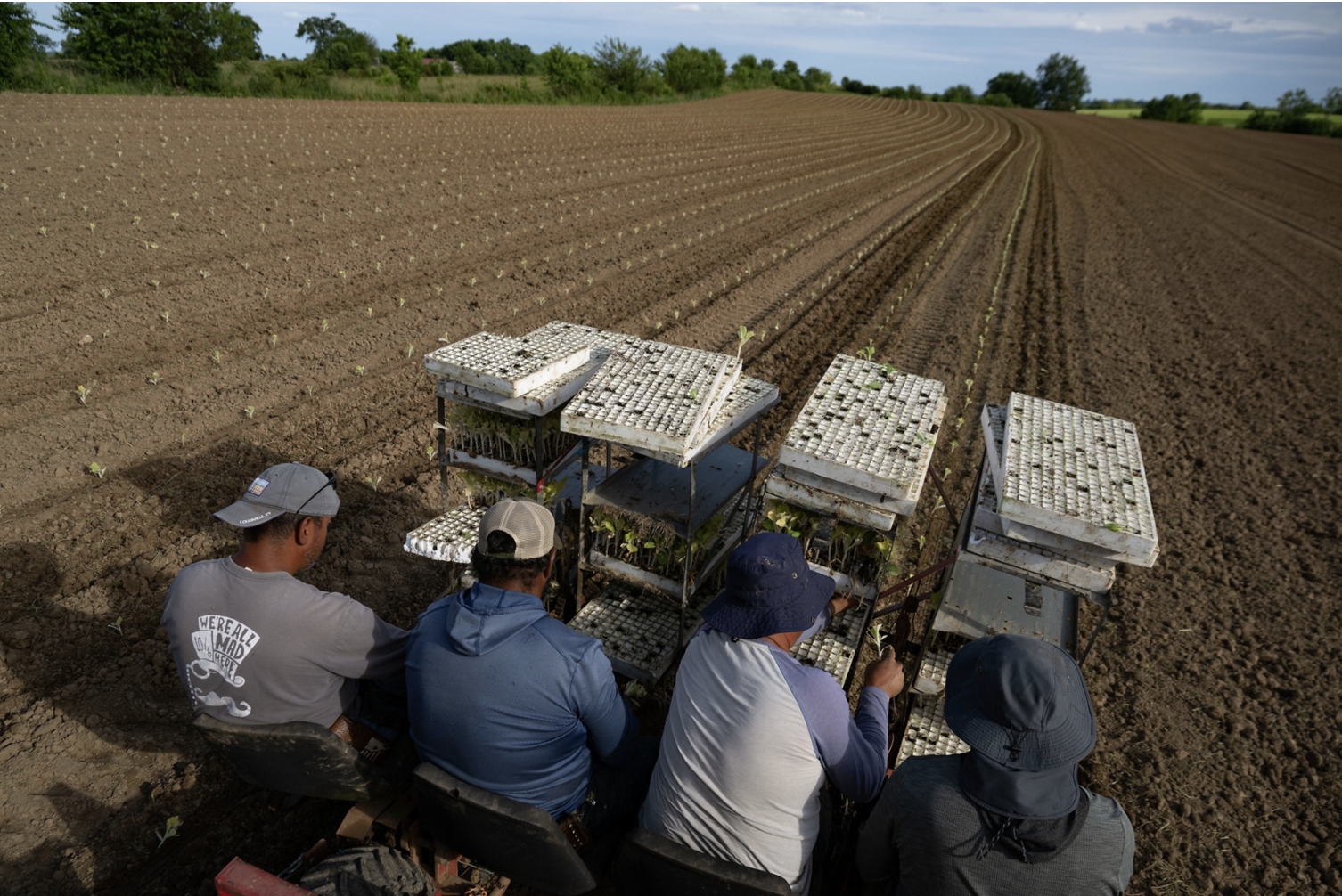
Stember did not stop at “workers plant tobacco.” He reported the identities, origins, employment circumstances and local historical significance of the people in his photograph. The image shows how tobacco was planted; the caption preserves who did the work and why it matters to Harrison County.
What makes the reporting exemplary
· IDENTITY: Five named workers and four reported ages show an effort to record individuals rather than anonymous labor.
· GEOGRAPHY: The Porfirio Diaz area of Mexico connects Harrison County’s agricultural story to another community and country.
· ECONOMICS: Reported wages and hours preserve a snapshot of working conditions that the camera cannot show.
· HISTORY: The caption situates the work within the decline of tobacco as a major local cash crop.
· RELATIONSHIPS: Mentioning that some workers are related opens an important line of human reporting beyond the activity itself.
What still needs editorial refinement
The pictured frame shows four workers, while the caption names five people associated with the operation but does note one is driving the tractor and likely not shown. Their exact positions need reconciliation; two “bucket hat” references are ambiguous. Confirm the missing age and full name where possible, relationships, the exact community of the farm, and the sources for wage, visa and historical claims. These are improvements to strong reporting—not reasons to overlook its achievement.
Teaching principle
A photograph documents what work looked like. Thoughtful field reporting preserves the workers’ identities, lives and place in history.
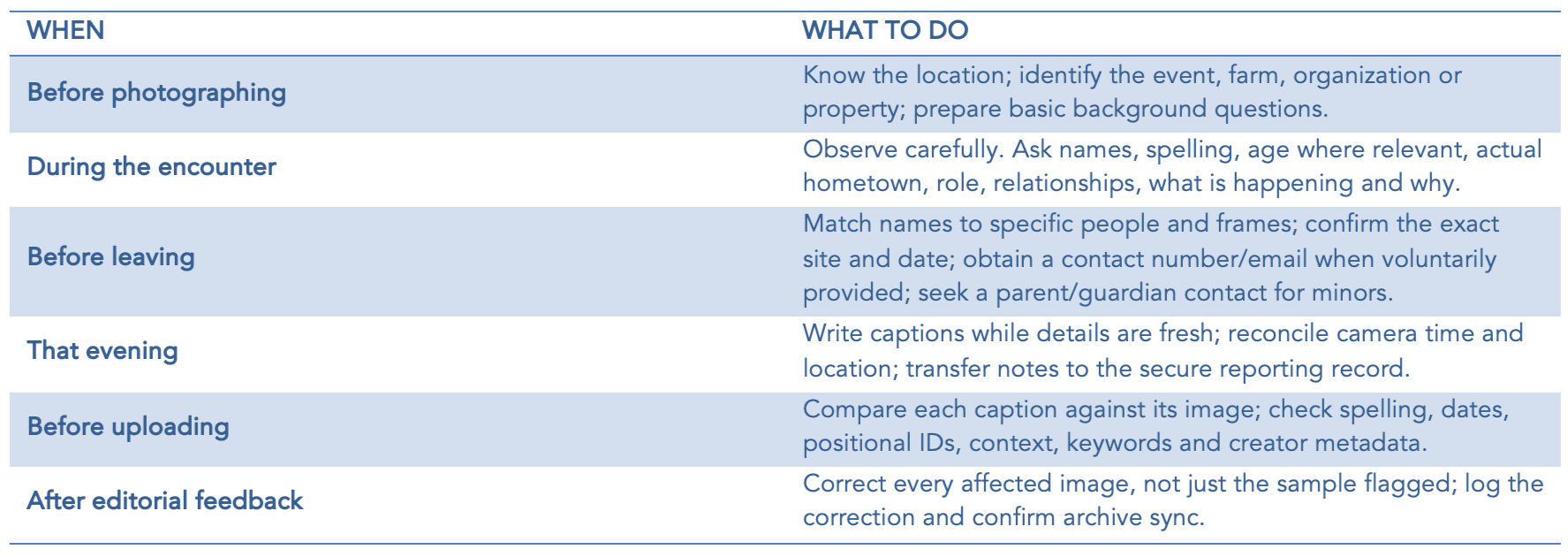
1 - Report before you caption
The field reporting sequence
Questions that make captions historically useful
· Who are you? How do you spell your first and last names? What name do you prefer to use?
· How old are you (if relevant)? Where do you actually live—not just your mailing address?
· What exactly are you doing? How long have you done it? Who taught you?
· What brought you here? Who else is involved? How are you related or connected?
· What has changed about this work, place or tradition over the years?
· What would you want someone looking at this photograph in 50 or 100 years to understand?
· May an editor contact you later? What phone number or email should we use, and is there a preferred method or time?
Do not turn every encounter into a rigid questionnaire. Listen, follow up and record the answers accurately. When a person declines to answer or cannot safely be approached, record that limitation rather than guessing.
2 - Notes that an editor can actually use
Make one reporting record per assignment or encounter and connect it to image filenames or frame numbers. Notes should be factual, dated and distinguish firsthand observation from what someone told you. More details and items can and should be added as needed.
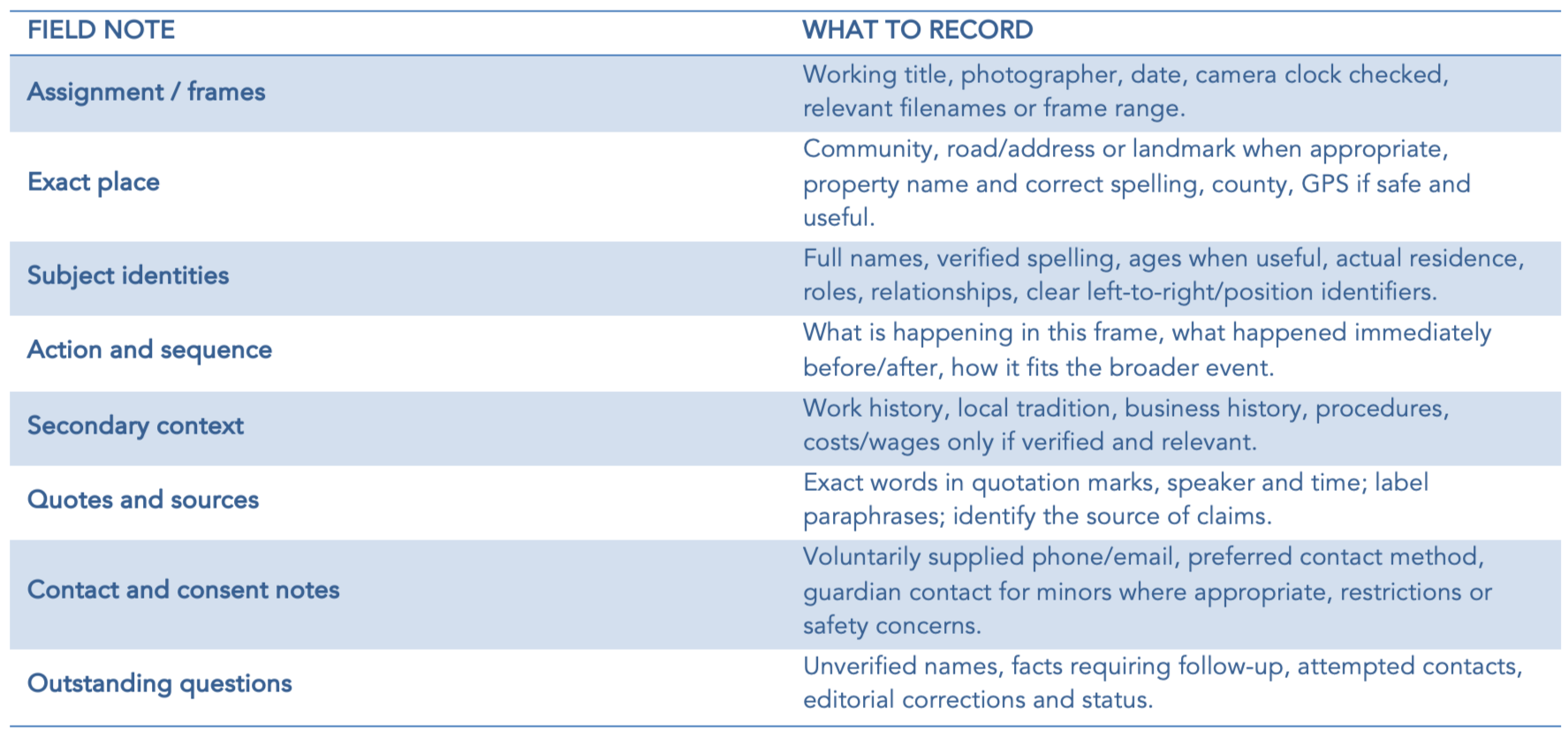
Sample field-note entry — blank reporting template
FRAME(S): __________ DATE / TIME: __________ ACTUAL COMMUNITY: __________
SUBJECT NAME / SPELLING: __________ AGE (if relevant): _____ ROLE: __________
POSITION IN FRAME: __________ ACTIVITY / WHY NOW: _______________________
BACKGROUND / HISTORY: __________________ QUOTE + SPEAKER: ______________
PHONE (PRIVATE): __________ EMAIL (PRIVATE): __________ CONTACT PERMISSION / PREFERENCE: __________
SOURCE / FACT CHECKS: __________ OPEN QUESTIONS / FOLLOW-UP: __________
Never place private phone numbers, email addresses, children’s contact details or other sensitive reporting notes in publicly distributed IPTC/XMP fields, PhotoShelter public descriptions or published captions. Store them in an appropriate and restricted, editor-accessible system with appropriate access controls as well as the XMP person shown field
3 - Anatomy of an excellent caption
A strong caption has a precise first sentence about the actual frame, followed by relevant verified context. It is concise enough to read, but not so thin that it loses the people and the history.
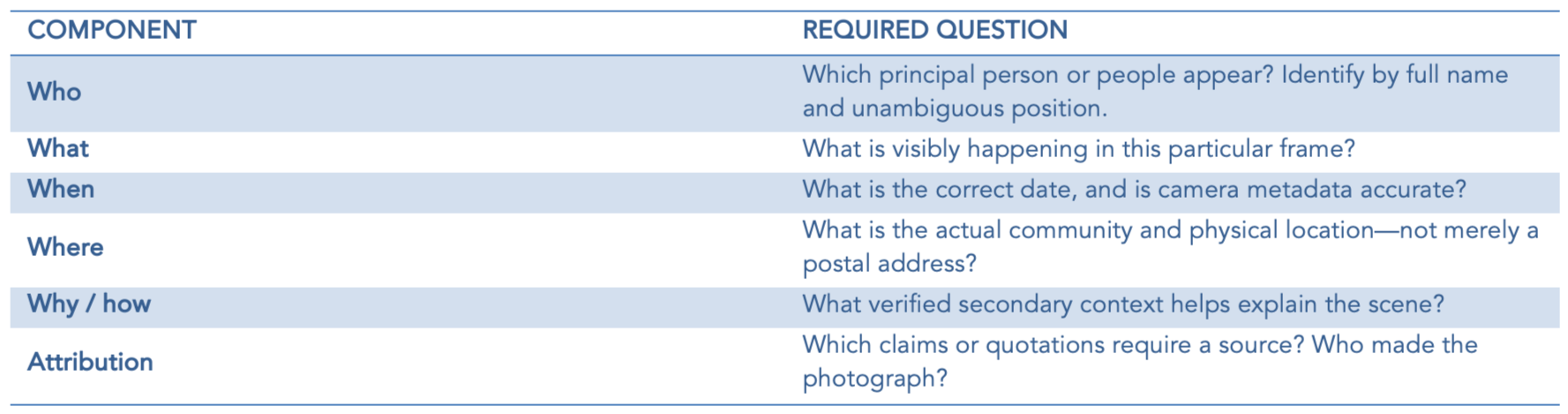
Caption writing rules
· Lead with the principal subject and action; avoid “Scenes from…” or “People enjoy…” as a substitute for reporting.
· Write a caption for the frame, not a generic caption for an entire take.
· Use present tense for the visible action when appropriate; date and contextual facts should be accurate.
· Identify people left to right or by clothing/position only when the description is unmistakable.
· Never infer a child’s feelings, a person’s immigration status, family relationships, ownership or motives from appearance.
· Quote only words actually recorded; do not invent dialogue or disguise paraphrases as direct quotations.
4 - Who is shown, tell the story
ORIGINAL SUBMITTED CAPTION — VERBATIM
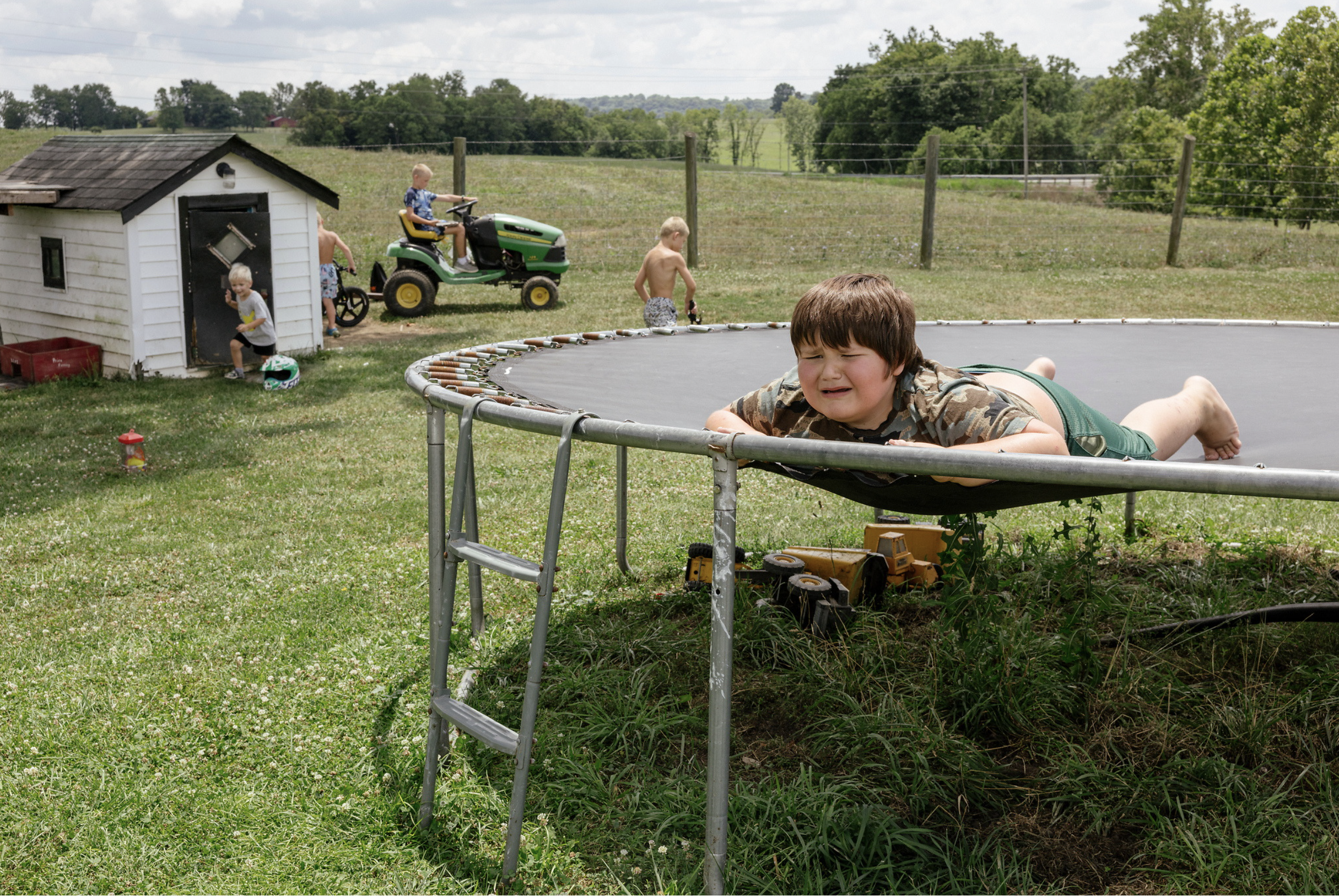
7/17/26; Berry, Kentucky; Brenna Price babysits four children, along with two of her own, in Berry, KY, on July 17, 2026. Price runs a babysitting company out of her house. Boyd, KY, on July 17, 2026. Boyd Winkle, 9, Rayland Winkle, 2, Branch, 8, Legend Cozart, 3, Levi Price, 9, and Dawson Price, 6, play in Brenna’s yard. Photograph by Maddie McCuddy
The original caption lists six children and describes them playing in the yard but does not identify the boy prominently pictured lying on the trampoline and appearing upset. It also gives conflicting locations.

Correction assignment: identify the boy and other principal visible children as feasible; verify the location; ask what happened without assuming; confirm the childcare arrangement; retain parent/guardian contact privately. Never invent a cause of distress.
5 - Side by side: same event, different reporting
ORIGINAL SUBMITTED CAPTION — VERBATIM
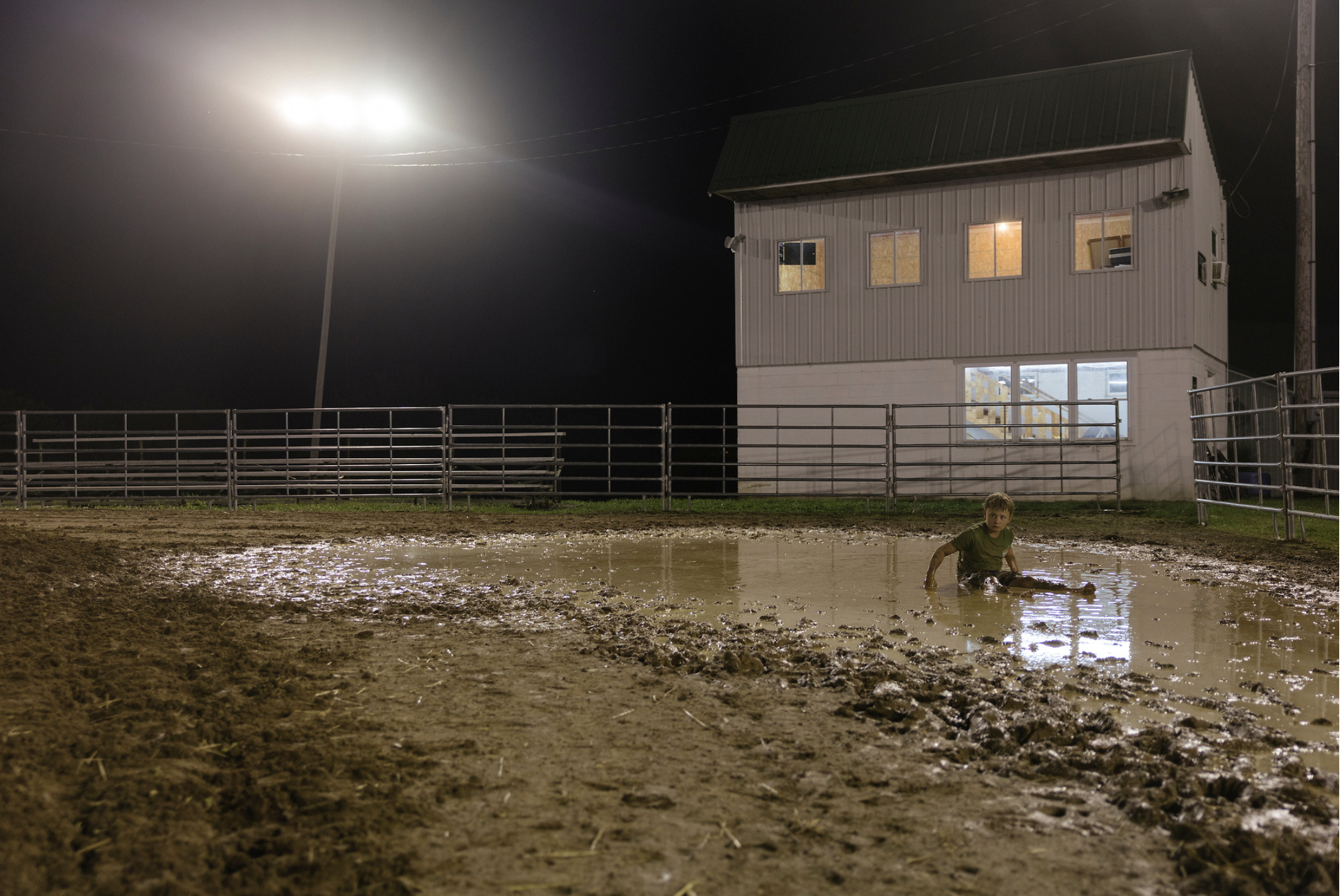
7/18/26; Cynthiana, Kentucky; Scenes from the greased pig contest at the Harrison County Fair in Cynthiana, KY, on July 18, 2026. Photograph by Maddie McCuddy
Original: “Scenes from the greased pig contest at the Harrison County Fair…” The image shows one boy sitting in a puddle at night, not a generic scene of competitors chasing a pig.
A provisional description may accurately say “an unidentified boy sits in muddy water,” but that is a placeholder for further reporting—not an acceptable substitute for reasonable identification efforts.
ORIGINAL SUBMITTED CAPTION — VERBATIM
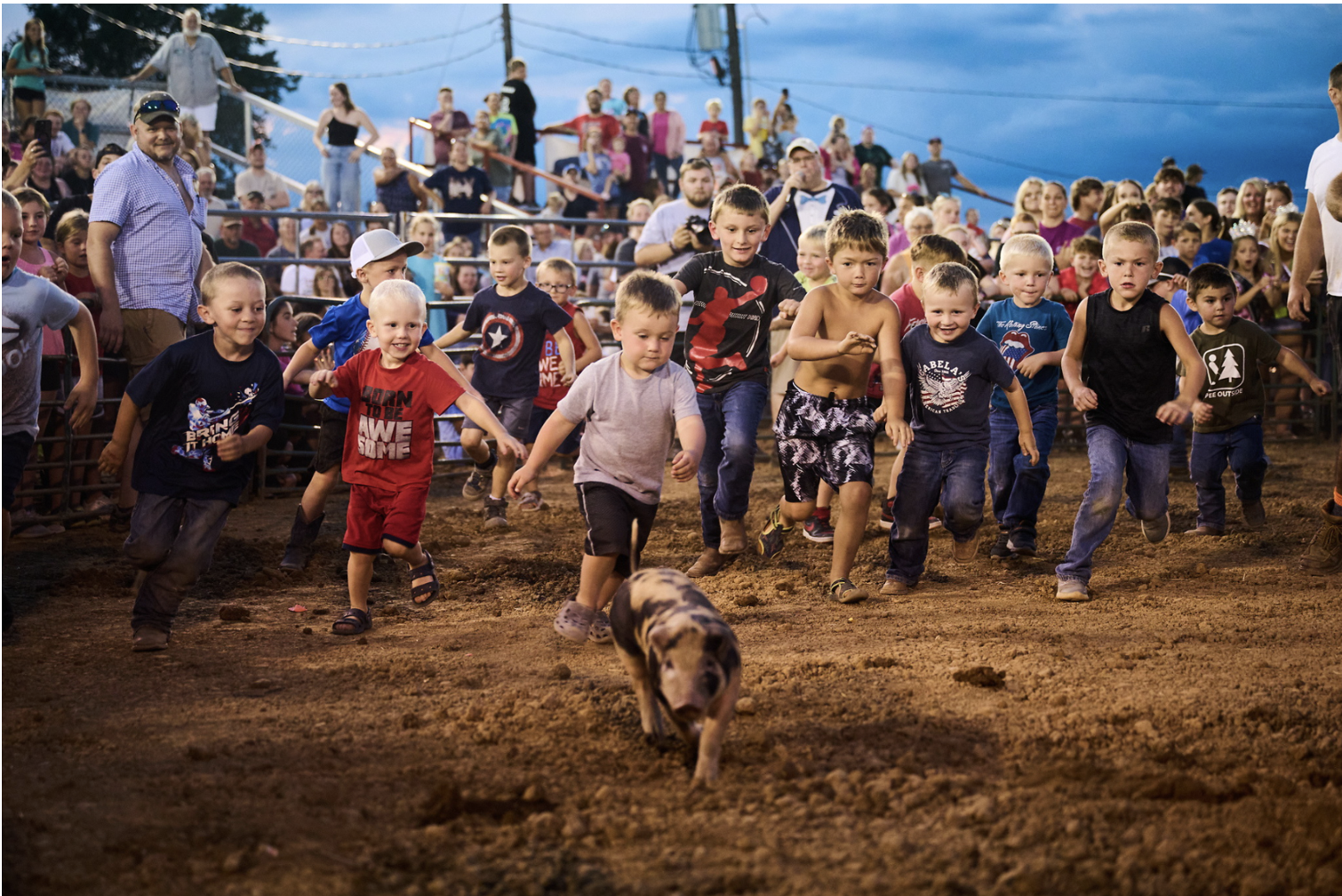
7/21/2023—Cynthiana, Kentucky — Competitors chase a pig at the greased pig contests Friday, July 21, 2023, at the Harrison County Fair in Cynthiana, KY. A local pig is lathered in a mixture of grease and various other viscous liquids to make it slippery, and contestants attempt to tackle and hold the pig. The winner will have held the pig anywhere from 30 to 60 seconds. In the upper age groups, the contestants must take the pig back to the trailer. Photograph by Lukas Flippo
Lukas’s caption explains how the contest works, why the pig is slippery and differences among age divisions. It still needs an effort to identify prominent children and verify which rules apply to the pictured division.

6 - Strong secondary reporting: the ordinary becomes history
ORIGINAL SUBMITTED CAPTION — VERBATIM
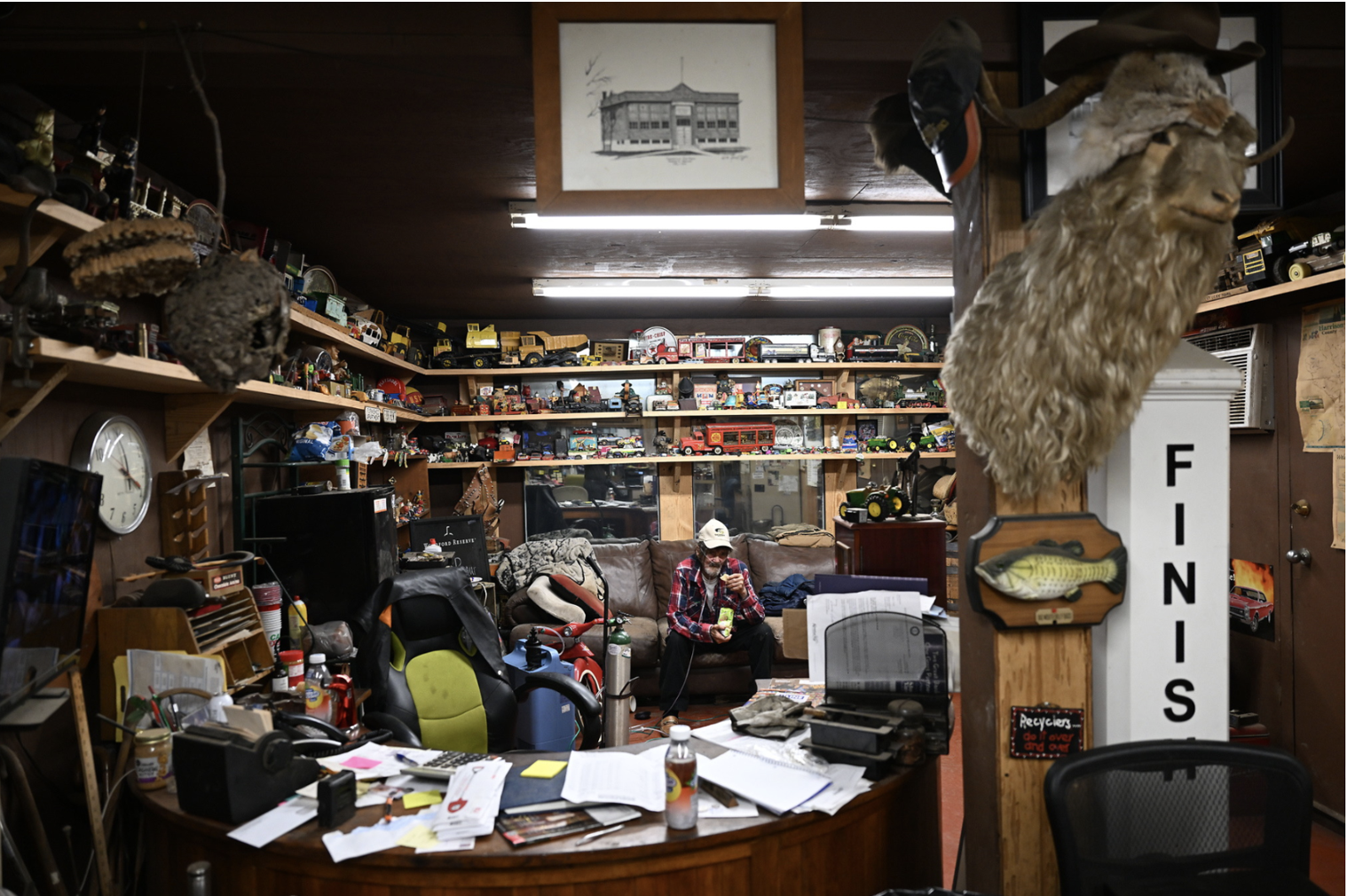
5/30/23—Cynthiana, Kentucky — Mark Shelton sits in the office of Randy’s Odd Jobs Recycling Center in Cynthiana, Kentucky, on Tuesday, May 30, 2023. Shelton worked at the center for years before retiring, and he still comes during the day to stay active and “in the know.” The center was founded after the floods of 1997, when owner Randy Northcutt saw an opportunity with the property to help with the massive cleanup efforts by amassing and transferring scrap metal and other recyclable goods.

Teaching point: “The photograph shows us where he is. The caption tells us why he is there.” Do not assume who owns objects in the room; ask.
7 - Side by side: tobacco farming and the people doing the work
ORIGINAL SUBMITTED CAPTION — VERBATIM
A group of migrant workers from the Porfirio Diaz area of Mexico, including Rogelio Gonzalez (tractor driver), 38, Felix Gutierrez (backwards hat), 42, Jesus Gonzalez (beard), Juan Miguel (bucket hat), 34, and Jesus Mendez (bucket hat), 45, set tobacco late into the evening at the Barnett family farm on Sunday, June 9, 2024. Tobacco used to be the primary cash crop of Harrison County and brought in a lot of cash into the community, but now very few farmers plant tobacco. These workers, some of which are related, come up from Mexico for the summer through the U.S. visa system. They typically work everyday 10-12 hours at $14 per hour. Photo by John Stember
WHY JOHN STEMBER’S PHOTOGRAPH AND CAPTION ARE EXEMPLARY
Stember’s caption does much more than describe workers planting tobacco. He identifies the people by name, age and position in the photograph, including the tractor driver and workers distinguished by their clothing or appearance. These details allow future archivists to connect specific individuals to the image rather than preserving them as anonymous laborers.
He also reports where the workers come from—the Porfirio Diaz area of Mexico—and explains their connection to Harrison County through seasonal agricultural employment. Details about their family relationships, visa arrangements, long workdays and reported hourly pay reveal the human and economic realities behind tobacco production. The historical context about tobacco’s declining role as a local cash crop gives the scene meaning beyond the moment photographed.
The caption establishes the date, identifies the Barnett family farm and describes the actual activity shown. It combines who, what, when and where with the deeper why and how that cannot be recovered simply by looking at the image. The precise geographic location of the farm should still be confirmed in the location metadata, and all reported details remain subject to normal fact-checking.
EDITORIAL STANDARD: This is the level of reporting Boyd’s Station expects on every ingested photograph. A visually strong image is not enough; the caption must preserve the identities, circumstances and local history that make it valuable to future generations.
CAPTION REVIEW —STRONG IMAGE, INCOMPLETE REPORTING
ORIGINAL SUBMITTED CAPTION — VERBATIM
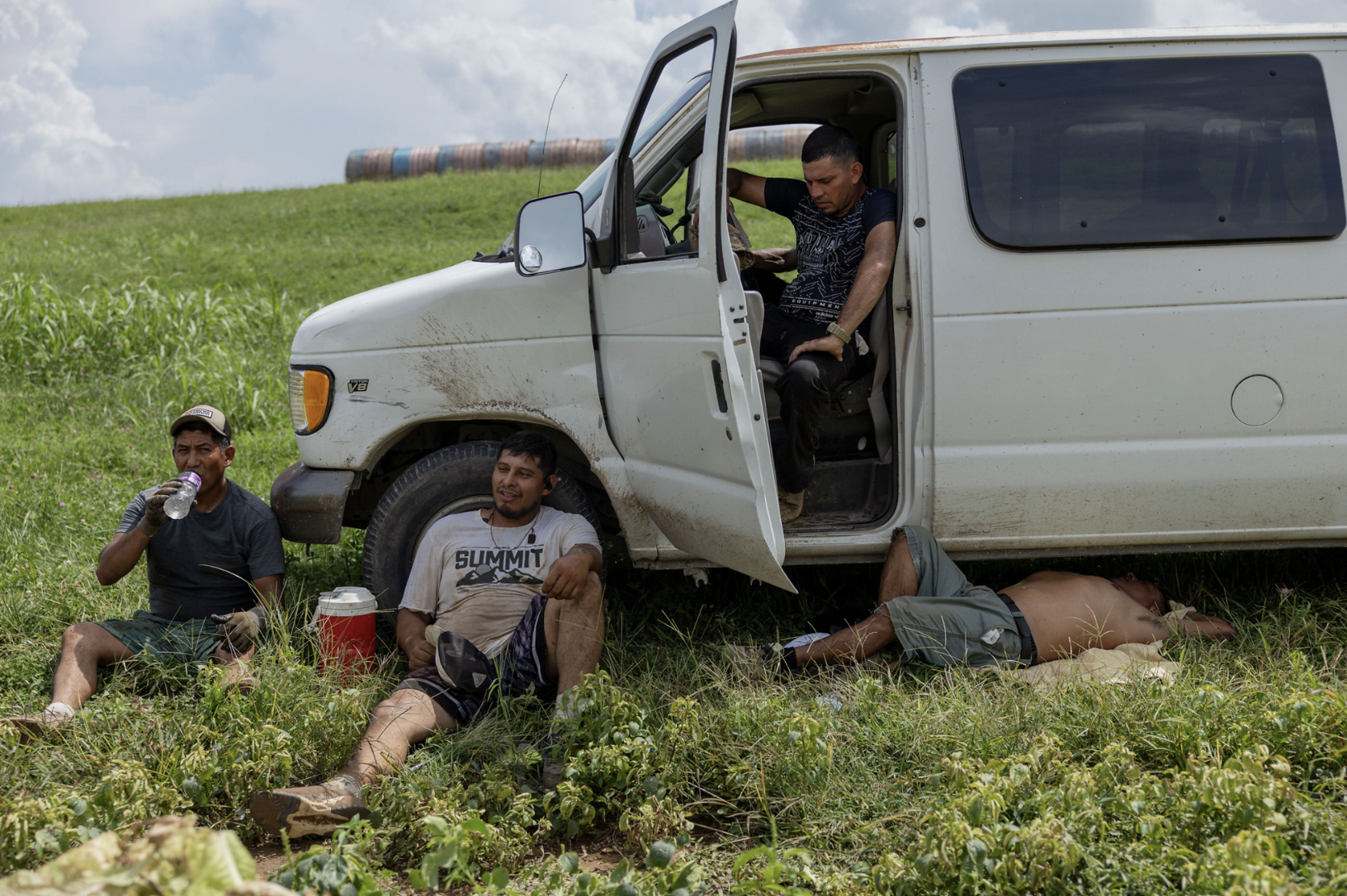
8/15/26; Cynthiana, Kentucky; H-2A workers cut a field of tobacco on Doug Dunaway’s farm on Saturday, August 14, 2026 in Cynthiana, Kentucky. Photograph by Lylee Gibbs
What the photograph shows—and what the caption fails to document
The image shows four men resting around and inside a white van at the edge of a field. The caption refers generally to H-2A workers cutting tobacco, but does not describe this particular frame or identify any of the men. Their names, roles, hometowns, and personal or work histories are missing. Their H-2A status should be supported by reporting, not inferred from appearance.
The location also needs verification. The caption repeatedly says Cynthiana, but the Dunaway farm may be near Boyd, approximately 15 miles away. The precise farm location and appropriate community dateline should be established from reporting, not assumed. The opening date is August 15, 2026, while the sentence says Saturday, August 14, 2026; August 14 was a Friday. The photographer must reconcile the actual exposure date and day of the week.
What additional reporting should establish
· Identify each principal person in the frame, with positions, verified spelling, and relevant background.
· Explain the moment: Are the men resting, or doing something else—based on interviews, not visual guesswork.
· Verify the farm’s exact location and the photograph’s correct date; explain the work and the workers’ relationship to the farm.
· Gather meaningful context about the workers’ experiences, employment, and connection to Harrison County, when available.
· Apply the corrected, frame-specific caption and complete IPTC/XMP metadata to this image in both matching archives.
Editorial Lesson
This is not a judgment of the photograph’s visual quality. It illustrates the difference between making a strong image and completing the reporting required for a permanent historical archive. Boyd’s Station expects both. Do not invent names, quotations, locations, or personal histories to fill the gaps. Return to notes, recordings, subjects, and other verifiable sources to complete the caption. Every ingested frame—not only selected images—must meet the same standard.
ORIGINAL SUBMITTED CAPTION — VERBATIM
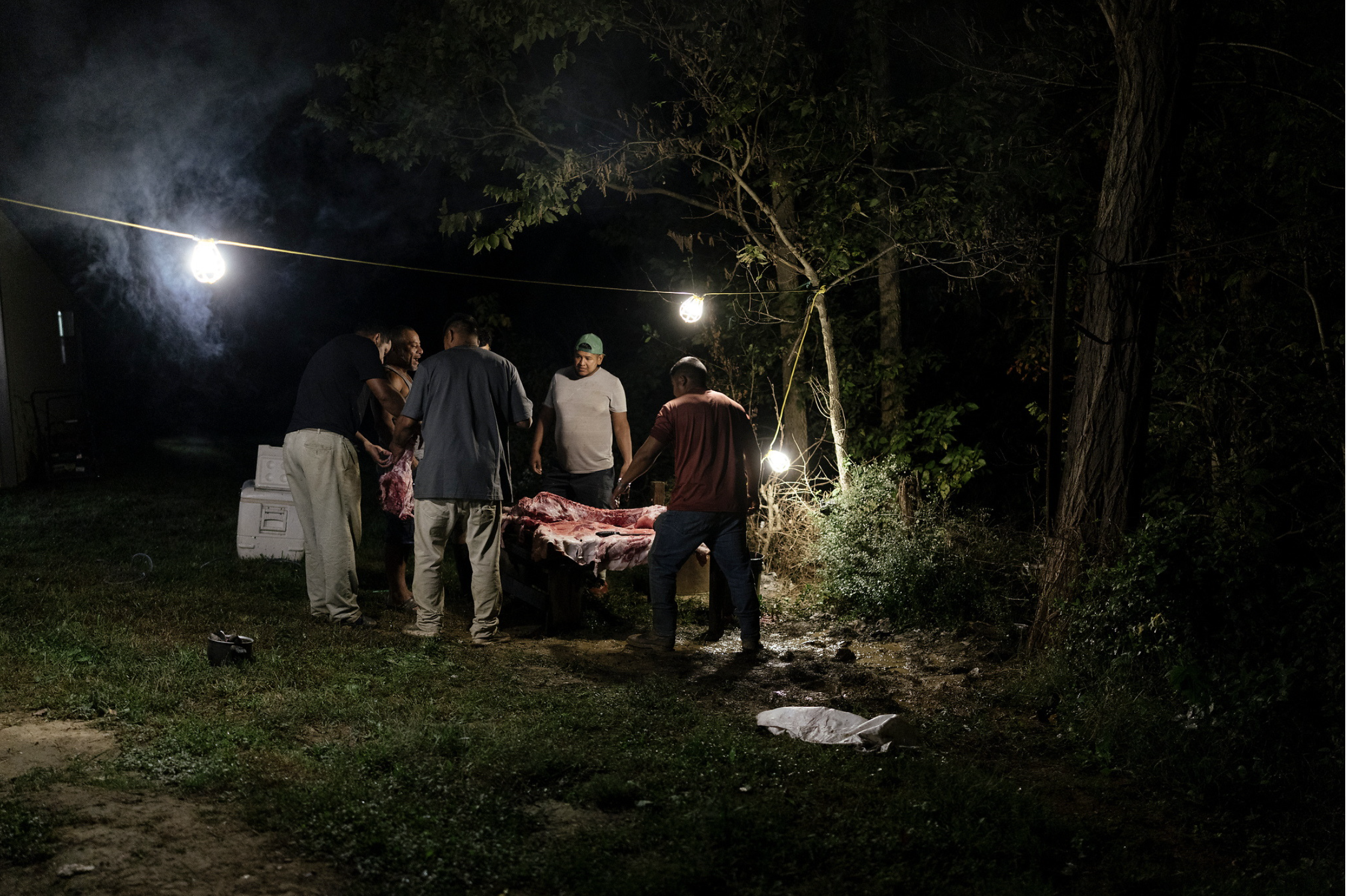
10/3/26; Boyd, Kentucky; Larry Jones gets ready to plan tulips in his front yard in Boyd Kentucky, October 5, 2026. Photograph by Maddie McCuddy
CRITICAL ERROR — THE CAPTION DESCRIBES AN ENTIRELY DIFFERENT PHOTOGRAPH. The submitted text says Larry Jones is preparing to plant tulips in his front yard. The accompanying image instead depicts several farm workers gathered outdoors at night around a work surface with what appears to be meat. There is no visible tulip planting, and the image does not establish that Larry Jones is present. This is not merely a short caption or a missed name: the words and the photograph describe fundamentally different situations.
WHY THIS MATTERS: A caption is the archival identification of an image. Attaching an unrelated caption can falsely identify people, activities, places and dates, potentially misleading editors, historians, families and researchers for decades. A polished photograph with incorrect metadata is not a complete archival submission. In this case, the header gives Oct. 3, 2026, while the sentence gives Oct. 5, 2026—another discrepancy that must be resolved against original capture records and reporting notes.
WHAT PROFESSIONAL PREPARATION REQUIRES: The photographer must inspect the actual frame while preparing its caption, not assume that a caption copied from a nearby file or contact sheet belongs to it. Verify the correct image-caption pairing, the capture date and exact location; identify the people visible and their positions; and report what they are actually doing and why. If the scene involves food preparation, agricultural work or a social gathering, establish that through interviews rather than guessing from appearances. Never assign H-2A status, nationality or employment relationships based on appearance.
CORRECTIVE ACTION: Set aside the mismatched image and caption for immediate review, locate the correct caption for this photograph and the correct photograph for the Larry Jones caption, and inspect adjacent frames for similar errors. Correct the affected captions and IPTC/XMP fields in both the uploaded archive and the provided hard drive, maintaining exactly matching filenames and folder structures. Keep a record of what was corrected and how the facts were verified. An unresolved placeholder is not a completed caption.
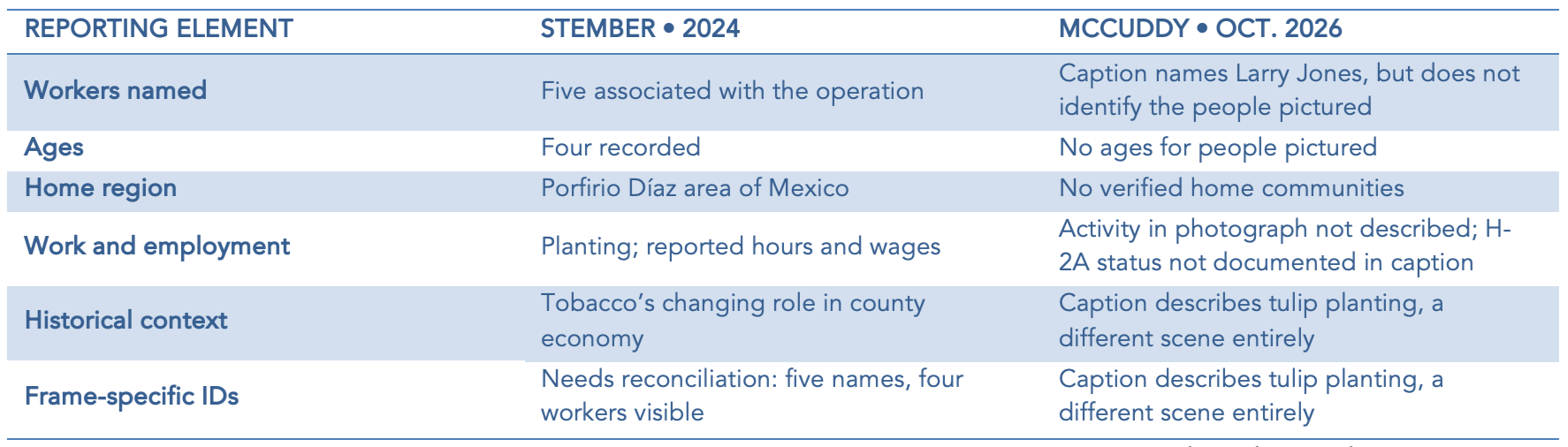
THE PROFESSIONAL STANDARD: Boyd’s Station expects diligence before delivery, not a future archivist to discover and repair preventable mistakes. Photographers may use Photo Mechanic, voice recordings, notes and caption drafts in any workflow that works for them, but they are responsible for a final frame-by-frame verification of every ingested image. The distinction is important: Lylee Gibbs’ nearby example has an image-related but seriously underreported caption; this Maddie McCuddy example has a caption that does not match the image at all. Both require correction, but the latter is a fundamental identification failure.
8 Additional illustrated lessons
ORIGINAL SUBMITTED CAPTION — VERBATIM
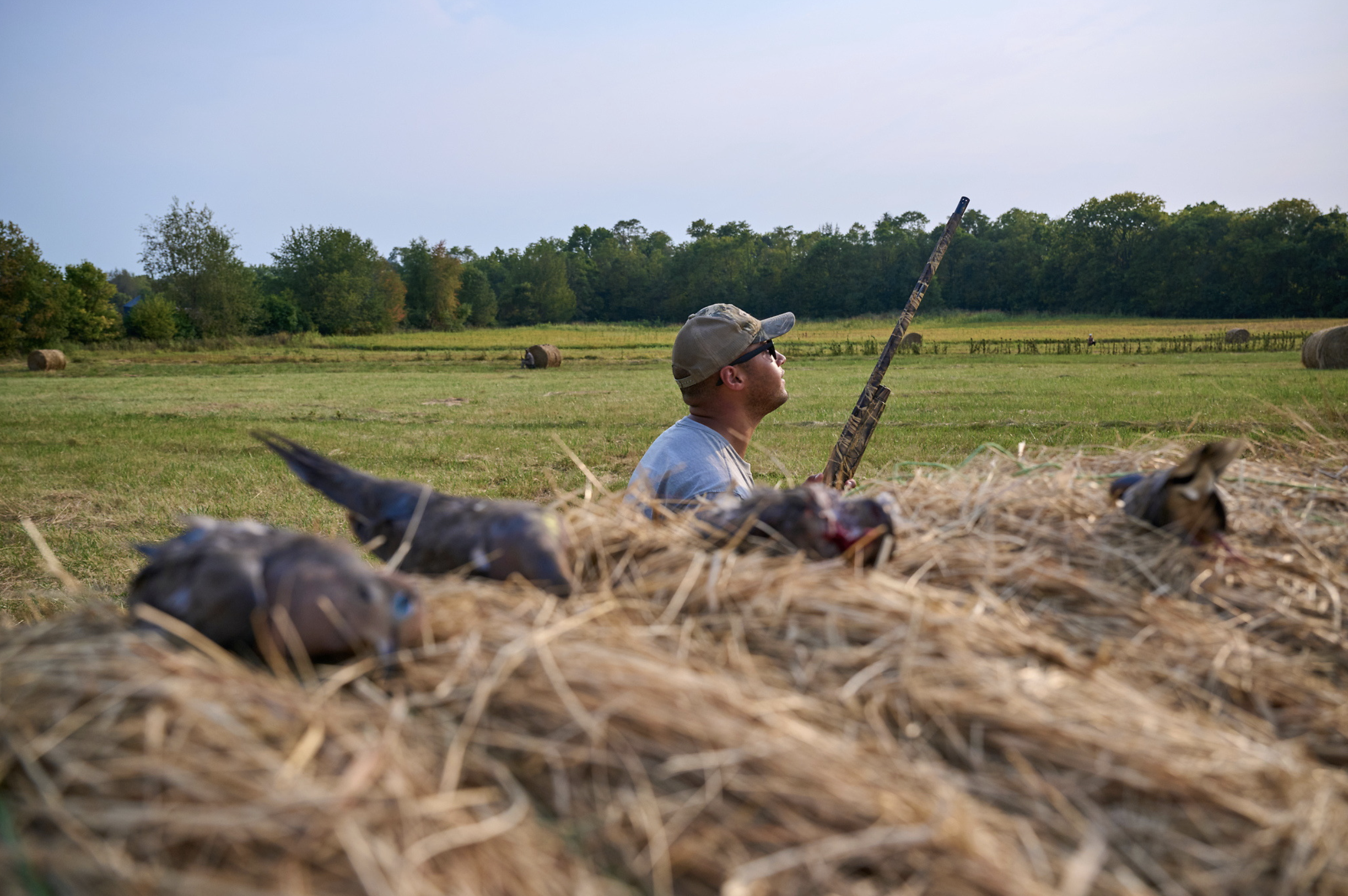
9/5/25; Ruddels Mills, Kentucky; Caleb Demus scans the horizon for incoming doves at a dove hunt on the McKee’s property near the intersection of Cook Road and Ruddels Fort Road. Photograph by Travis LaCoss
Strong foundation: identifies Caleb Demus, his action and a specific location. Next step: ask his age, hometown, connection to the property, history of hunting here and any relevant personal or family tradition. Do not assume he harvested the birds in the foreground.
ORIGINAL SUBMITTED CAPTION — VERBATIM
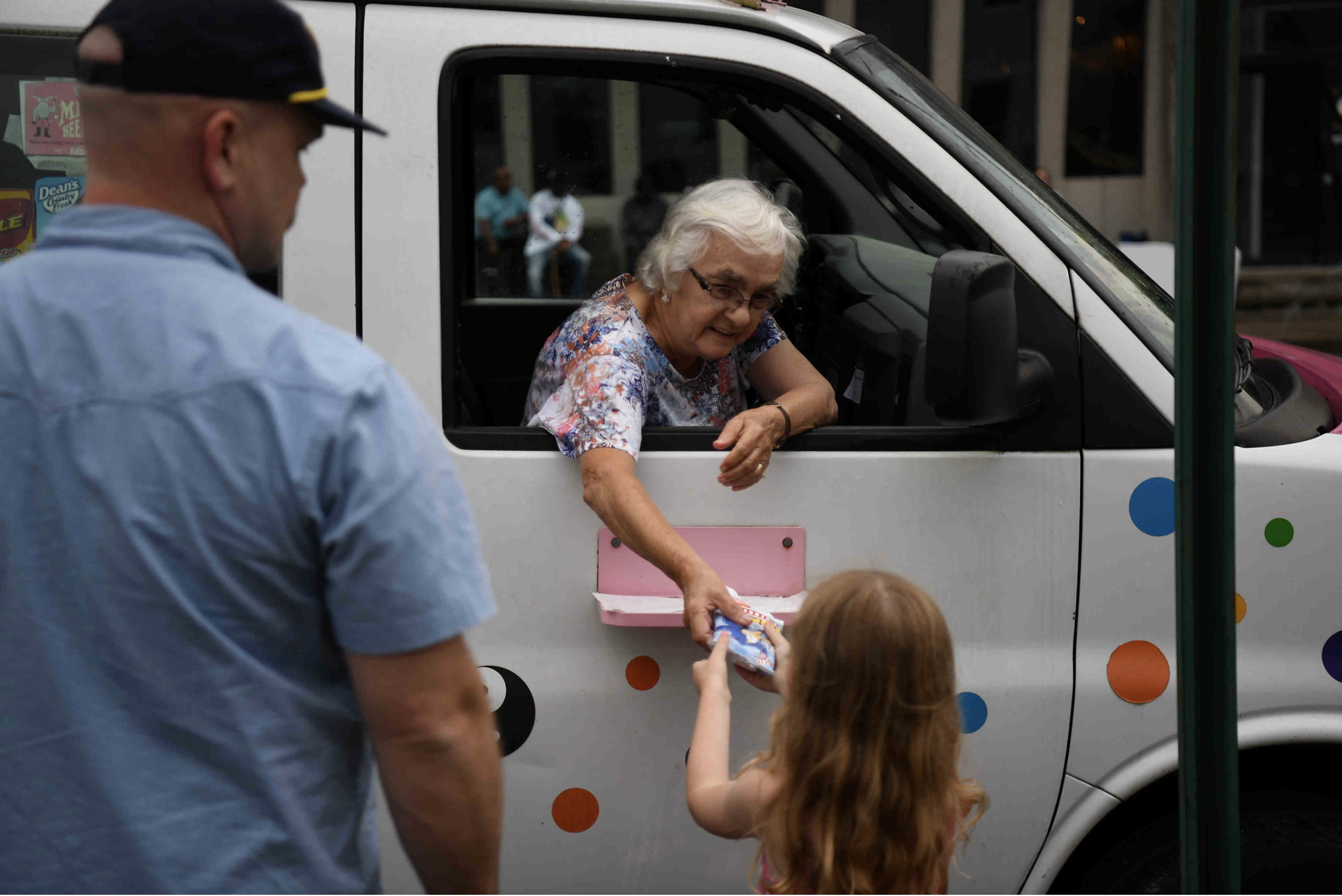
6/10/22; Cynthiana, KY; George and Donald Dietz sell ice cream from the Brooks Ice Cream truck during the Summer Concert Series in Cynthiana on Friday June 10, 2022. Photograph by Jesse Barber
Original caption names George and Donald Dietz and Brooks Ice Cream, but does not clearly identify the woman serving a treat, the child receiving it or the man in the foreground. Identify people in the actual interaction, then add verified business and event context.
9 Accuracy and sensitivity are both professional skills
ORIGINAL SUBMITTED CAPTION — VERBATIM
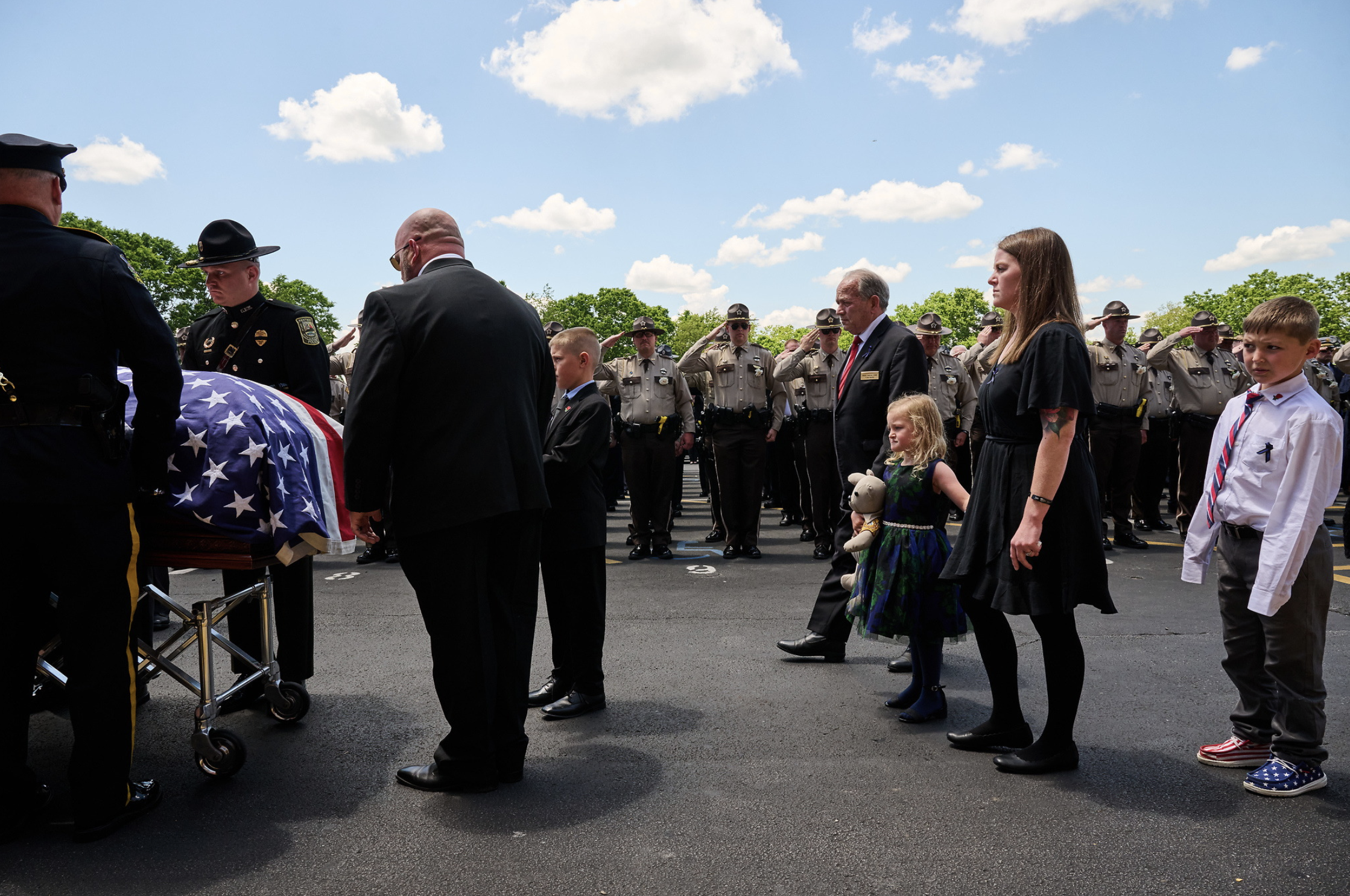
6/1/23— Cynthiana, KY — The Conley family, including son Riley Conley (center), daughter Olivia Conley (right), wife Rachel Ann Conley, and nephew Lincoln Conley (far right), watch Scott County Sheriff’s Deputy Caleb Conley’s coffin get loaded into a hearse June 1, 2023, in Georgetown, Kentucky, to depart for the burial service at Battle Grove Cemetery in Cynthiana, Kentucky. Thousands of people from across Kentucky, including many police departments and first responders, attended the funeral and graveside burial service for fallen Scott County Sheriff’s Deputy Caleb Conley on June 1, 2023, in Georgetown and Cynthiana, Kentucky. The funeral, which was held at the Scott County High School gymnasium in Georgetown, preceded a procession to the Battle Grove cemetery in Cynthiana where a burial service was held. Conley was killed while conducting a routine traffic stop May 22, 2023, on I-75 outside Georgetown. Photo by Lukas Flippo
The submitted caption identifies family relationships and provides substantial funeral and burial context. Its heading says Cynthiana while the described frame was made in Georgetown. The image location must be Georgetown if verified; the burial destination is a separate location. Confirm all positional identifications and historical claims.
Sensitive reporting: do not pressure grieving relatives for quotes or interviews. Use funeral programs and reliable official sources where appropriate. Record how information was verified.
10 The private contact record is a reporting requirement
For each principal adult subject, make a reasonable, respectful attempt to collect a phone number and email address for editor or future researcher follow-up. Explain why the information is requested and how it will be used. Subjects may decline. Record the attempt without penalizing refusal.
· Ask: “May a Boyd’s Station editor contact you later to verify details or follow up on your story?”
· Confirm the number and email by reading them back; record preferred contact method and best time.
· For minors, seek a parent/guardian’s contact details where appropriate; do not solicit private contact information directly from children.
· Keep the contact database separate from public captions, image metadata and public archive downloads. Restrict access to authorized editors and protect against unauthorized disclosure.
· For workers or vulnerable subjects, be especially careful about privacy, potential retaliation and the implications of collecting identifying or immigration-related information.
11 Metadata, archive submission and correction protocol
A repeatable weekly review
· Select representative images from each day and inspect the caption against the actual frame.
· Run a date, location, subject-name and spelling check across the full take.
· Look for copied generic captions, inconsistent community names and unresolved identification placeholders.
· Resolve the editor’s correction log by the agreed deadline; check all images sharing an erroneous template or fact.
· Confirm the revised metadata has reached the archive and that private contacts remain restricted.
When standards are not met
Boyd’s Station should distinguish lack of skill from repeated failure to review or correct work. Provide clear instruction and documented editorial feedback, set a reasonable correction deadline, and evaluate observable follow-through. Persistent deficiencies may trigger early termination under the signed residency agreement. Serious misconduct may require immediate action. A subject’s refusal to provide information is not itself a photographer failure when reasonable reporting efforts are documented.
Final pre-upload checklist
· I can identify the principal subject(s) and match names to positions in the image.
· I have checked actual date, actual community, property/business name and spelling.
· My caption describes this frame—not merely the event.
· I have added relevant, verified context and attributed direct quotations.
· I recorded subject follow-up phone/email when voluntarily provided, or documented why unavailable.
· Private contacts and sensitive notes are stored securely, not in public metadata.
· I have reviewed the image and caption together and corrected related errors across the assignment.
FINAL PRINCIPLE: The photographer’s responsibility does not end when the shutter closes or the files upload. It ends when the work has been reported, verified, reviewed, corrected and responsibly preserved.
12 - YOU HAVE THE NAMES. BUT DO YOU HAVE THE STORY?
ORIGINAL SUBMITTED CAPTION — VERBATIM
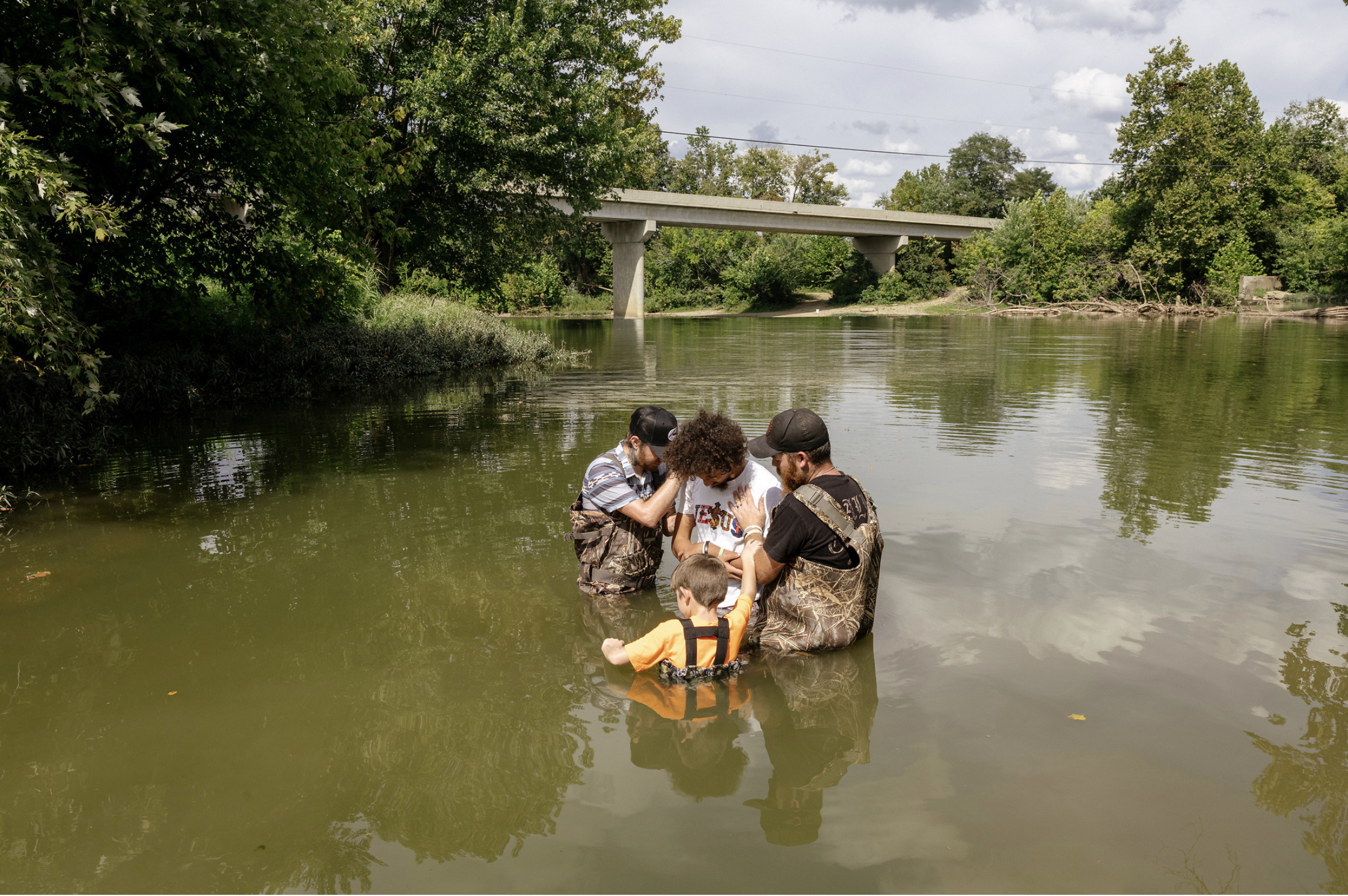
8/29/26; Berry, Kentucky; Ty White gets baptized by Dillon Price at the Robinson Dam in Berry, KY, on August 30, 2026. White, saw a video of his friend Kyle Workman (left) get baptized in the river and decided to do it himself after wanting to be baptized for so many years. “We aren’t quite apart of any particular denomination,” said Tessa Price. “We just want to have a relationship with Jesus.” Photograph by Maddie McCuddy
The original wording and conflicting dates above are deliberately retained for teaching. No facts have been silently corrected.
What the photographer did well
· Identifies Ty White as the person being baptized and Dillon Price as the person conducting the baptism.
· Names Kyle Workman and reports that seeing a video of his baptism influenced Ty’s decision. This is meaningful secondary reporting that cannot be inferred from the image.
· Records an attributed quotation from Tessa Price about the participants’ approach to faith.
· Identifies a specific local landmark rather than only saying “in Kentucky.”
The reporting gaps — image versus caption
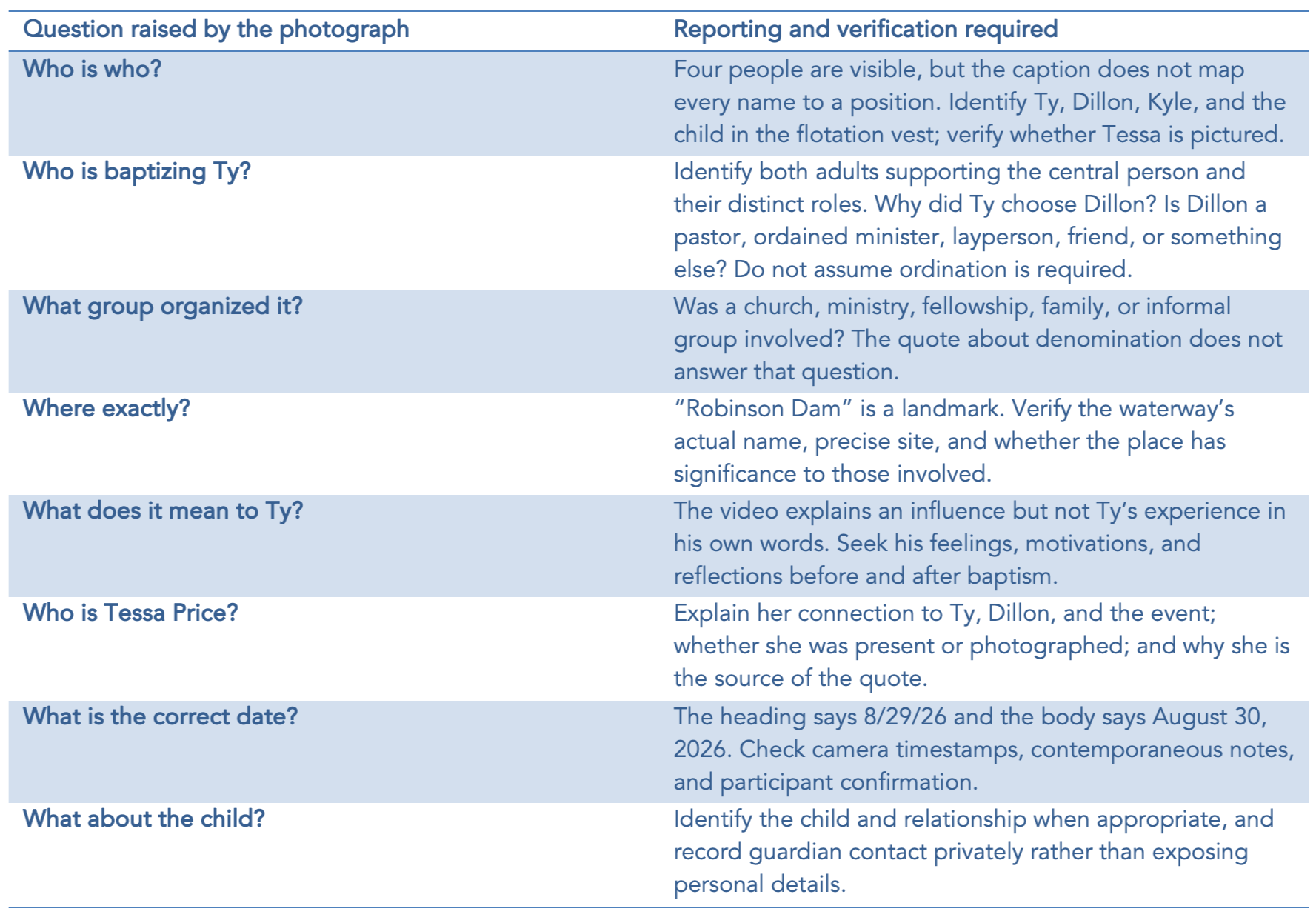
Field questions that could have told the story
· Ty: Why did you choose to be baptized now, after wanting to do so for years? What did Kyle’s video mean to you? How did you feel before and afterward?
· Dillon: What is your relationship to Ty? What is your role in this baptism? Are you affiliated with a church or other group?
· Other adult: Who are you, and what role are you playing in this moment?
· Tessa: Who are you in relation to the participants? Were you present? What did you mean by your quoted statement?
· Everyone: Why this location? What is the name of the river? Was this part of a larger gathering?
Basic event description versus complete documentary reporting
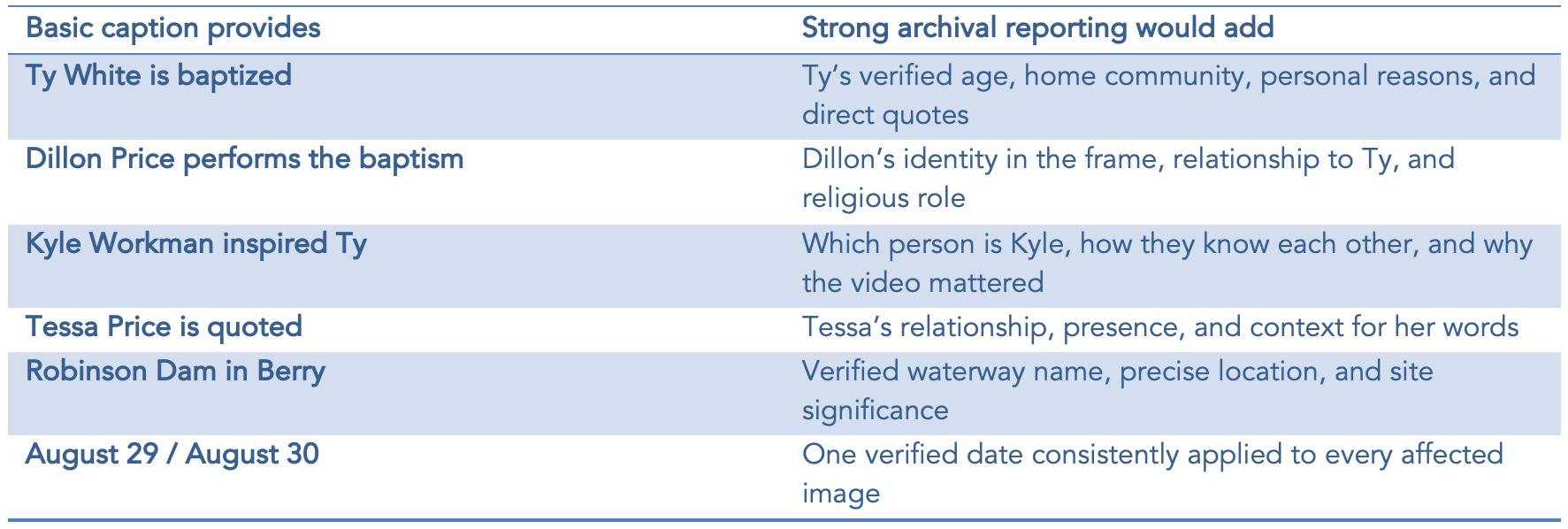
Editorial correction assignment
1. Return the full baptism take for a frame-by-frame identification and caption review; do not merely fix one example.
2. Verify the actual date, waterway and physical location, and establish all relationships and religious roles.
3. Seek direct personal testimony from Ty, without manufacturing a quote or pressuring participants to speak.
4. Record voluntary phone numbers and email addresses for editorial follow-up in a restricted contact log. For the child, seek appropriate guardian contact. Never place private contacts in public captions or IPTC/XMP fields.
5. Document unresolved questions and sources of verification. Correct related metadata throughout the assignment and confirm completion with the editor.
Teaching takeaway
A caption is not complete simply because it contains names, a location and a quote. The information must explain who the people are, how they are connected, what happened, and why it mattered to them.
Good reporting gathers the facts. Good editing verifies them. A documentary archive requires both.
13 - DON’T ASSUME. VERIFY.
The historical consequences of getting it wrong
A photograph may be authentic while its caption is inaccurate. Once an unverified claim is entered into the Boyd’s Station archive, later researchers, journalists and families may repeat it as established history. A mistake can outlive the photographer who made it.
Teaching example: The tornado that never happened
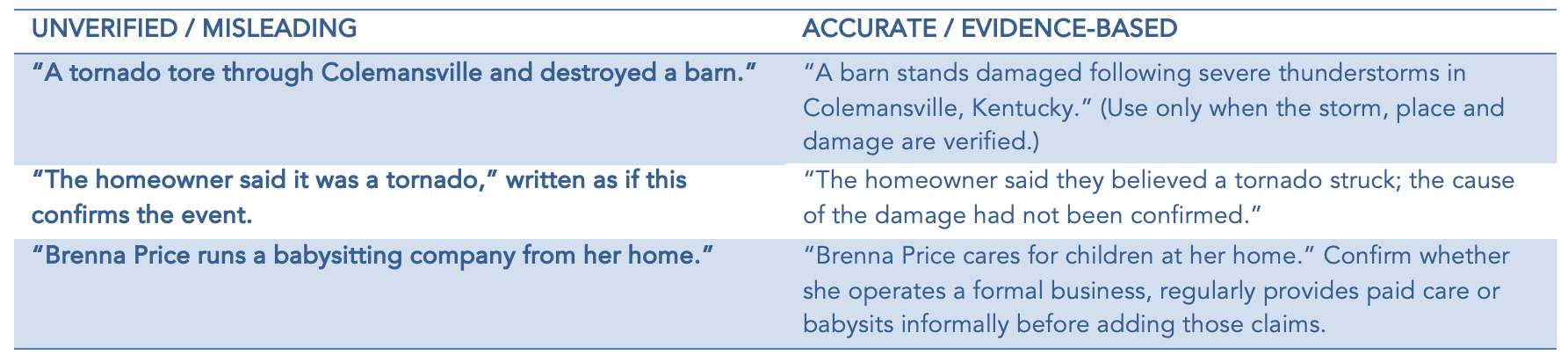
Imagine a photographer documenting storm damage in Colemansville, Kentucky. A resident looks at a damaged barn and says, “That must have been a tornado.” Without checking, the photographer captions the image as a tornado that tore through Colemansville. Years later, a historian finds the photograph and repeats that claim—even though no tornado occurred. The photograph accurately shows damage; the caption creates a false historical event. This is a hypothetical example illustrating the risk, not a claim about an actual Colemansville storm.
What the photographer must do
· Separate direct observation from a subject’s opinion, recollection or speculation.
· Verify consequential claims with appropriate sources: for tornado classification, check National Weather Service storm reports and surveys, and relevant local emergency management information.
· Record the source and verification status of each material claim in field notes: confirmed, attributed but unverified, or unresolved.
· Do not treat attribution as proof. A quote can accurately document what someone believes without establishing that belief as fact.
· If the facts cannot be established, use precise, limited wording that describes only what is known. Do not fill gaps with assumptions.
· Preserve willing adult subjects’ phone numbers and email addresses in secure editor-accessible reporting records; obtain appropriate parent/guardian contact information for minors. Never place private contact details in public captions or IPTC/XMP fields.
· When new evidence corrects an error, update every affected caption, keyword, template and archival record; document the correction and source.
Connection to the illustrated case studies
The trampoline caption describes Brenna Price as running a “babysitting company,” although the caption alone does not establish the legal or practical nature of her childcare arrangement. The Dunaway tobacco captions repeatedly misspell the farm’s name as “Duniway.” The baptism caption gives conflicting dates. These are different failures of the same editorial duty: check what a caption asserts, verify it, and correct errors across the full assignment.
CORE RULE: A caption must document what the photographer can establish—not what the photographer assumes.
14 - Model captions: what fully reported work could look like
TRAINING EXAMPLES ONLY — ALL ADDITIONAL DETAILS AND ALL QUOTATIONS BELOW ARE INVENTED FOR INSTRUCTION.
These model captions demonstrate structure, specificity, verified-style attribution, and the value of secondary reporting. They are NOT corrected historical captions and must NEVER be copied into PhotoShelter, IPTC metadata, publication captions, or the historical archive. Names, ages, hometowns, relationships, quotations, employment details, dates and site histories added below are hypothetical unless already supplied in the original case studies. Replace every invented detail with independently confirmed reporting before publication.
1. Dove hunter — Travis LaCoss
FICTIONAL MODEL — NOT FOR ARCHIVAL USE
Caleb Demus, 34, of Paris, Kentucky, watches for doves from a straw-covered blind during a hunt on the McKee family property near Cook Road and Ruddels Fort Road in Ruddels Mills, Kentucky, on Sept. 5, 2025. Demus said he began hunting here with his grandfather when he was 12 and now returns each September with childhood friends. “It’s as much about seeing everybody again as it is about the birds,” he said. Several doves harvested during the hunt rest on the blind in the foreground.
Teaching value: A named subject and action; precise location; age, hometown and personal connection; a firsthand quote; distinction between visible birds and who harvested them.
2. Ice cream truck — Jesse Barber
FICTIONAL MODEL — NOT FOR ARCHIVAL USE
Mary Dietz, 72, hands an ice cream sandwich to Emma Collins, 6, as Emma’s father, Daniel Collins, watches beside the Brooks Ice Cream truck during the Summer Concert Series on Main Street in Cynthiana, Kentucky, on June 10, 2022. Dietz said she and her husband, George, have operated the truck at community events for 18 summers. “The children remember us from one year to the next,” she said.
Teaching value: Identifies the woman, girl and man by position and relationship; separates operators from visible subjects; gives exact venue and local business history.
3. Trampoline and home childcare — Maddie McCuddy
FICTIONAL MODEL — NOT FOR ARCHIVAL USE
Boyd Winkle, 9, cries while lying on a trampoline in the yard of Brenna Price’s home in Berry, Kentucky, on July 17, 2026, after arguing with another child over a game, according to Price. Price said she regularly provides paid childcare for three neighboring families while caring for her own children; she described the arrangement as independent babysitting, not a registered childcare company. Other children play near a small tractor and playhouse in the background.
Teaching value: Identifies the boy and verified reason for distress; resolves the community; carefully characterizes childcare without implying an established company.
4. Boy in mud at fair — Maddie McCuddy
FICTIONAL MODEL — NOT FOR ARCHIVAL USE
Ethan Parker, 7, sits in a muddy puddle after competing in the children’s greased pig contest at the Harrison County Fair in Cynthiana, Kentucky, on July 18, 2026. Parker said he slipped while chasing the pig and stayed in the puddle to cool off. “I didn’t catch it, but I got the muddiest,” he said. His mother, Sarah Parker, said it was his first year entering the contest.
Teaching value: Connects the individual to the contest; explains why he is in the puddle; records age, hometown-context, a quote and family perspective.
5. Greased pig contest — Lukas Flippo
FICTIONAL MODEL — NOT FOR ARCHIVAL USE
Children race after a greased pig during the 6-to-8-year-old division at the Harrison County Fair in Cynthiana, Kentucky, on July 21, 2023. Among the competitors are, from left, Mason Reed, 7, in a navy shirt; Eli Turner, 6, in red; and Noah Bell, 8, shirtless. Fair organizer Rebecca Hall said competitors in this division must hold the pig for 30 seconds to win; older divisions follow different rules. “It’s the event the kids ask about all year,” Hall said.
Teaching value: Names selected identifiable children, not every spectator; verifies the rules for the pictured division; includes organizer attribution and community context.
6. Recycling center — Lukas Flippo
FICTIONAL MODEL — NOT FOR ARCHIVAL USE
Mark Shelton, 68, of Cynthiana, Kentucky, eats lunch in the office of Randy’s Odd Jobs Recycling Center on May 30, 2023. Shelton said he worked at the business for 24 years before retiring in 2021 and still visits most weekdays to see former coworkers. Owner Randy Northcutt said he opened the recycling operation in 1998 after collecting scrap metal during cleanup following the 1997 floods. “I retired from the job, not the people,” Shelton said.
Teaching value: Explains why the man is there; records tenure, relationships and business origins; attributes the history and quote.
7. Deputy Caleb Conley funeral — Lukas Flippo
FICTIONAL MODEL — NOT FOR ARCHIVAL USE
Rachel Ann Conley, wife of Scott County Sheriff’s Deputy Caleb Conley, stands with family members as officers prepare to move his flag-draped casket following funeral services in Georgetown, Kentucky, on June 1, 2023. Son Riley Conley stands beside the casket; daughter Olivia Conley stands next to her mother, and nephew Lincoln Conley is at far right. Officers salute before a procession to Battle Grove Cemetery in Cynthiana. Family identifications were confirmed with the printed funeral program and a family representative.
Teaching value: Correctly distinguishes the Georgetown photograph from the Cynthiana burial; identifies positions and relationships; explains verification without manufacturing a grieving family quote.
8. Barnett farm tobacco setting — John Stember
FICTIONAL MODEL — NOT FOR ARCHIVAL USE
Felix Gutierrez, 42, left, Jesus Gonzalez, 39, second from left, Juan Miguel Reyes, 34, third from left, and Jesus Mendez, 45, right, feed tobacco seedlings into a mechanical setter at the Barnett family farm near Berry, Kentucky, on June 9, 2024. The four men are seasonal farmworkers from the Porfirio Díaz region of Mexico. Gutierrez said he has returned to Harrison County for six planting seasons and sends much of his earnings home to his family. The crew said they typically work 10 to 12 hours a day during planting; farm records reviewed by the photographer showed a wage of $14 an hour that season.
Teaching value: Keeps the original strengths—names, ages, home region, wages, work hours, agriculture—while tying only visible people to positions and sourcing employment claims.
9. Tobacco hanging at Dunaway farm — Maddie McCuddy
FICTIONAL MODEL — NOT FOR ARCHIVAL USE
Luis Hernández, 31, of Oaxaca, Mexico, balances on a wooden beam while hanging cut tobacco inside a curing barn at the Dunaway farm in Boyd, Kentucky, on Aug. 24, 2026. Hernández said this was his fourth season working on the farm through the federal H-2A program. He and coworker Mateo Cruz, 28, visible at right, lift and space the tobacco so air can circulate as the leaves cure. “You have to watch every step up here,” Hernández said.
Teaching value: Identifies both workers, verifies H-2A status, describes the process, and spells Dunaway correctly.
10. River baptism — Maddie McCuddy
FICTIONAL MODEL — NOT FOR ARCHIVAL USE
Ty White, 19, center, is baptized by his friend Dillon Price, 32, right, with assistance from Kyle Workman, 21, left, in the South Fork of the Licking River near Robinson Dam in Berry, Kentucky, on Aug. 30, 2026. White said he had considered baptism for several years and decided to take the step after watching a video of Workman’s baptism. “I wanted to make the decision for myself, with people who know me,” White said. Price said he is not ordained and that the ceremony was organized by friends rather than a church. Price’s son, Owen, 6, stands in front wearing a flotation vest. Tessa Price, Dillon’s wife, who was present but is not pictured, said the group is not affiliated with a denomination.
Teaching value: Identifies everyone and positions; names the river; establishes religious role, group, relationships, the child and Tessa; prioritizes Ty’s own words; resolves the date.
11. Nighttime meat processing — Maddie McCuddy
FICTIONAL MODEL — NOT FOR ARCHIVAL USE
From left, Miguel Santos, 38, Andrés López, 44, Rafael Cruz, 29, and José Medina, 41, prepare beef for a shared meal at a farm near Boyd, Kentucky, on Oct. 3, 2026. The men, seasonal agricultural workers from central Mexico, said they bought the meat together and divided it after their shift. “We cook together on our days off because it reminds us of home,” Santos said. Farm manager Daniel Brooks confirmed that the workers were employed through the H-2A program.
Teaching value: Replaces the entirely mismatched tulip caption with a frame-specific example; identifies the men, activity, date and actual relationships, while requiring verification of meat, employment and context.
Field reporting checklist for every model
Verify actual date and community; identify principal subjects and their positions; establish relationships, ages and hometowns; ask why this moment matters; collect accurately attributed quotes; confirm employment, titles, business status and official claims; record a source for every consequential fact; collect phone/email contacts with consent in the private editorial contact log; protect children’s and vulnerable subjects’ information; revisit and correct all affected photographs when errors recur.
15 - Daily complete-take uploads and editorial review
High-speed internet available to residents makes it possible for Boyd’s Station to receive and review the full photographic record every day, rather than relying only on weekly selections or end-of-residency deliveries. This is an archival, reporting and editorial accountability requirement—not a demand to photograph constantly.
Daily ingest and upload standard
· Every day photographs are made, ingest the complete take, retain original filenames and capture metadata, and back up the camera cards before formatting or deleting anything.
· Upload the complete take to the designated secure Boyd’s Station server or archive intake area by the agreed daily deadline. Include all frames, not only selects, portfolio favorites or edited pictures. Record any missing, corrupt or withheld files and the reason.
· Preferred workflow: preserve original RAW files plus review JPEGs or previews, with adequate local backup. A JPEG-only transfer workflow may be approved when bandwidth, storage or equipment requires it, but the policy must explicitly state whether and where original RAW files are retained and delivered.
· Use a consistent folder structure, capture date, photographer name and assignment identifier. Preserve camera EXIF capture times and original file identities; reconcile incorrect camera clocks and time zones.
· Apply the existing caption, IPTC Persons Shown, location, keyword and creator standards to EVERY ingested photograph before upload. Every frame requires an accurate, frame-specific caption, including non-selects and unedited images. Unverified details must be explicitly flagged with a follow-up plan in restricted notes; do not misrepresent provisional images as archive-ready.
· Upload or link a brief private daily reporting log: locations visited, assignments attempted, people contacted, reporting/interview work, subjects photographed, emerging story leads, outstanding questions and any barriers. Store subject phone numbers and emails only in restricted reporting records, never public image metadata.
What administrators will be able to review
· Complete-take volume and distribution of photographic activity across dates, times, locations, assignments and subject matter.
· Whether captions actually match individual frames, identify principal people, use correct spellings and geography, and supply sufficient secondary reporting.
· Whether residents are expanding coverage into new communities, businesses, everyday life and archive gaps while progressing on personal stories.
· Unresolved reporting questions, repeat errors, incomplete uploads and the time taken to make requested corrections.
EXIF timestamps show when exposures occurred—not when the photographer began or ended work. Time spent interviewing, driving, gaining access, researching, editing, captioning and making calls may leave no photographic timestamp. Administrators must not equate the number of exposures or gaps in shooting with hours worked or overall productivity. Evaluate the complete reporting record and outcomes, taking account of safety, weather, access and assignment complexity.
Daily editorial workflow
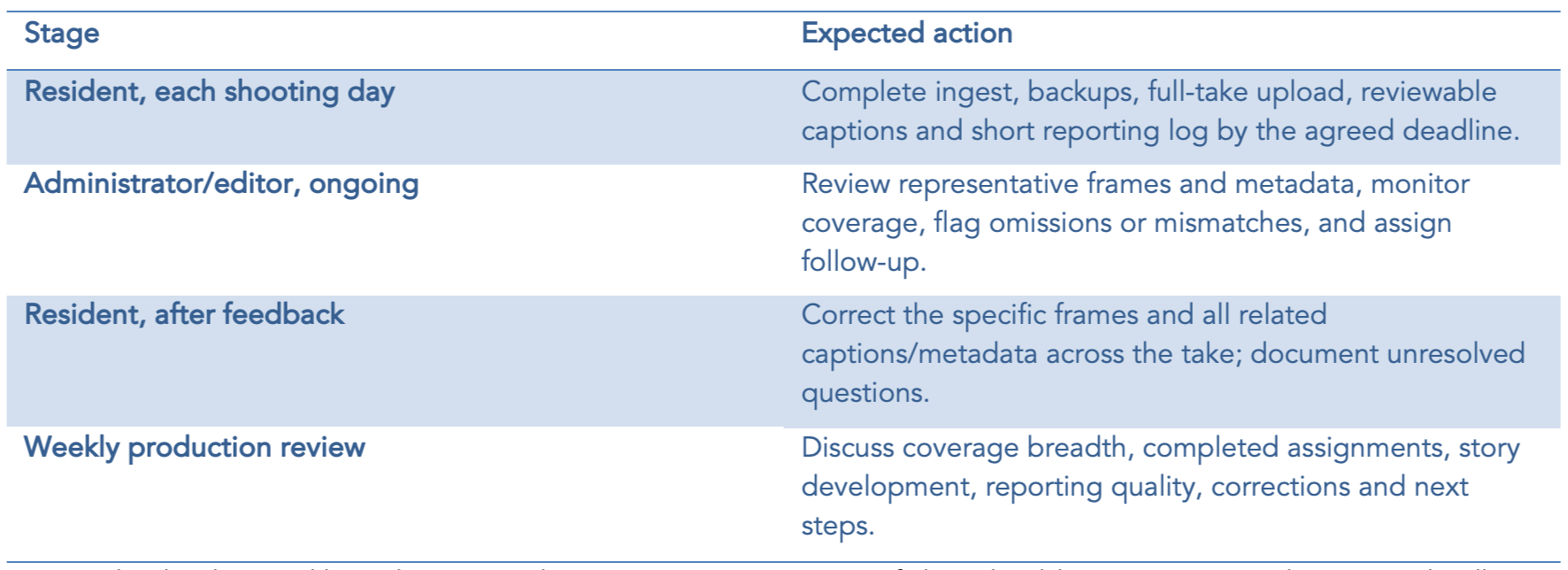
A missed upload caused by a documented connectivity or equipment failure should trigger an agreed recovery deadline, not an automatic judgment about effort. Secure access, retention, storage capacity, RAW/JPEG delivery specifications and reviewer responsibilities must be finalized before the 2027 residency begins.
2027 IMPLEMENTATION RULE: A daily upload is not the same as editorial acceptance. A photograph enters the historical archive as complete only when its caption, identity, date, location and supporting metadata have been reviewed and are sufficiently accurate for future use.
EXEMPLARY CAPTION
A model of complete identification, contextual reporting, and lasting archival value.
Original caption — preserved as submitted
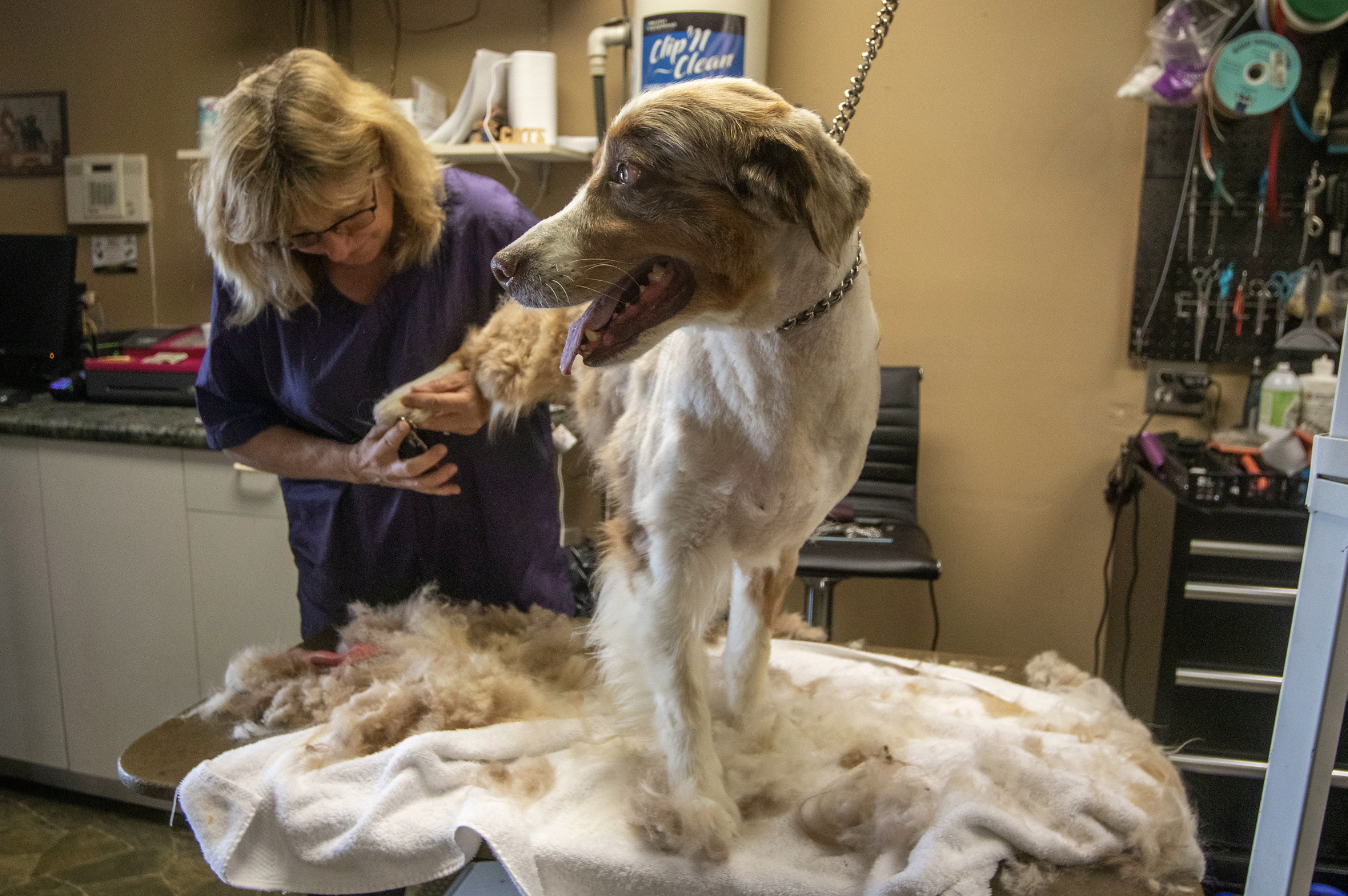
7/07/22; Cynthiana, KY; Susan Caskey, 61, works on grooming Amos at Animal House at 105 Railroad Avenue on Thursday, July 7, 2022. Susan initially went to school for computer science, but realized it was not her passion. She had an interest in animals and decided to stop by a pet groomer to see if they were hiring. The manager said he was potentially firing someone that day and to call back the next day to check if a spot was available. Susan was hired and has now spent 40 years in the pet grooming business. Photograph by Annie Barker
Why this caption meets the Boyd’s Station standard
This photograph documents an ordinary moment in the working life of a Harrison County resident. The caption identifies the subject, the dog, the business, the street address, the date, and the activity. It also preserves Susan Caskey’s personal history: her initial study of computer science, the chance inquiry that led to her first grooming job, and her 40-year career. None of that history can be recovered by looking at the image alone.
This is the level of reporting and contextual detail Project 306.36 expects for every ingested photograph—not only the strongest selects. Each frame must be accurately described and identified, with verified information embedded in its metadata before archival delivery. A strong image without a strong caption is an incomplete historical record.
EXEMPLARY CAPTION
A strong example of reporting that reveals the realities of local journalism and preserves a community story.
Original caption — preserved as submitted
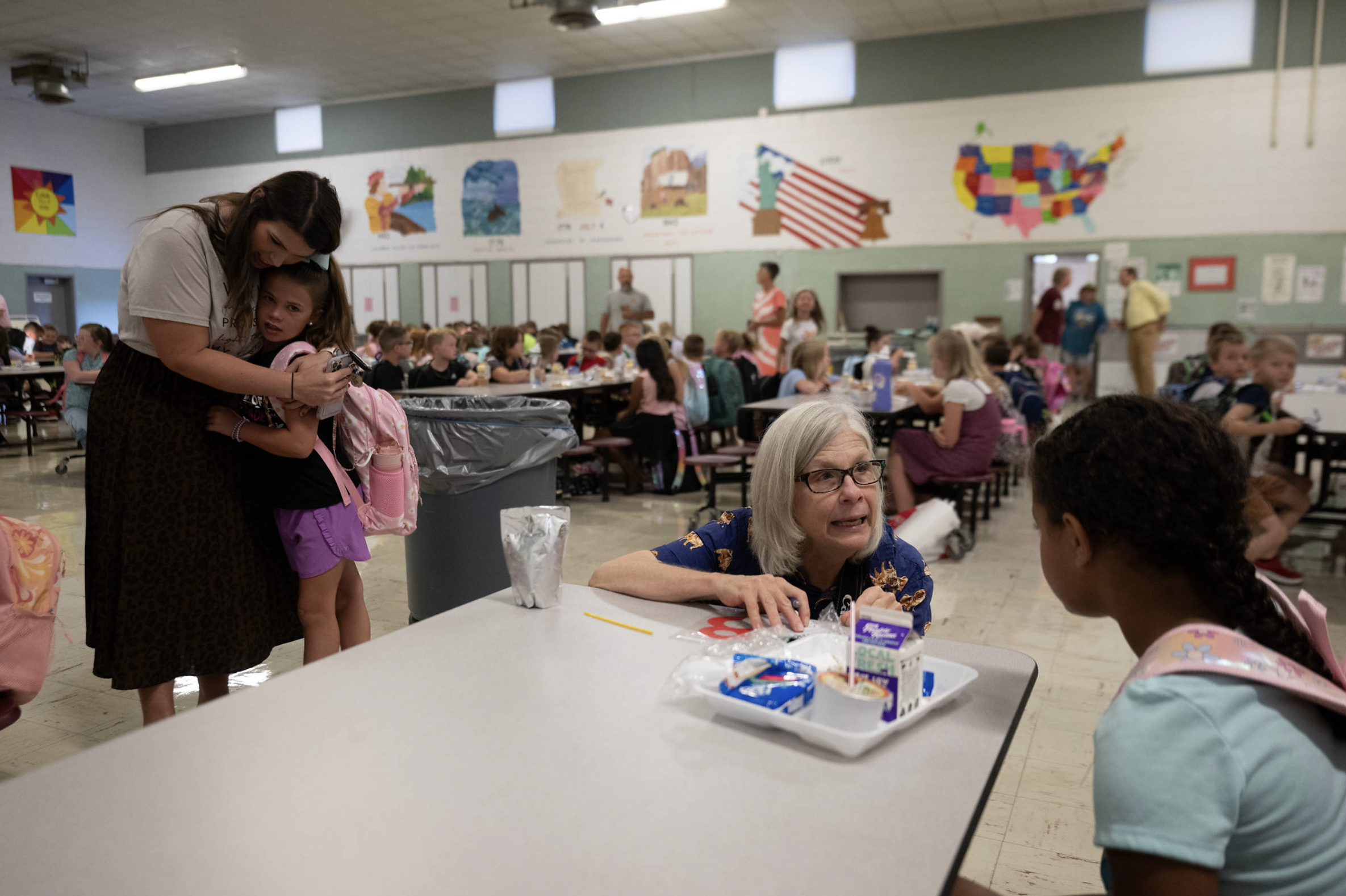
8/08/22; Cynthiana, KY; Betsy Smith, editor of both the Cynthiana Democrat and Grant County News, reports on the first day of school at Eastside Elementary on Thursday, August 8, 2024. Smith has been working full time for both small town newspapers since June 2023. She does not have any formal training in journalism but loves to write. “People still think there’s a whole newsroom. It’s kind of like the Wizard of Oz. Don’t look behind the curtain and see two journalists doing the whole paper,” Smith said. Photo by John Stember
Why this caption meets the Boyd’s Station standard
John Stember identifies Betsy Smith, her role as editor of two local newspapers, the school setting, and the date. More importantly, his reporting explains a reality that the photograph alone cannot reveal: how a small number of journalists sustain local news coverage. Smith’s own words preserve her perspective and give future readers insight into the working conditions of community journalism in 2024.
This is the archival value of a thoroughly reported caption. It connects a moment at an elementary school to the people and institutions serving Harrison County. The same expectation applies to every ingested photograph, not only those selected for publication or exhibition.